The Business Case for More Humour and Playfulness
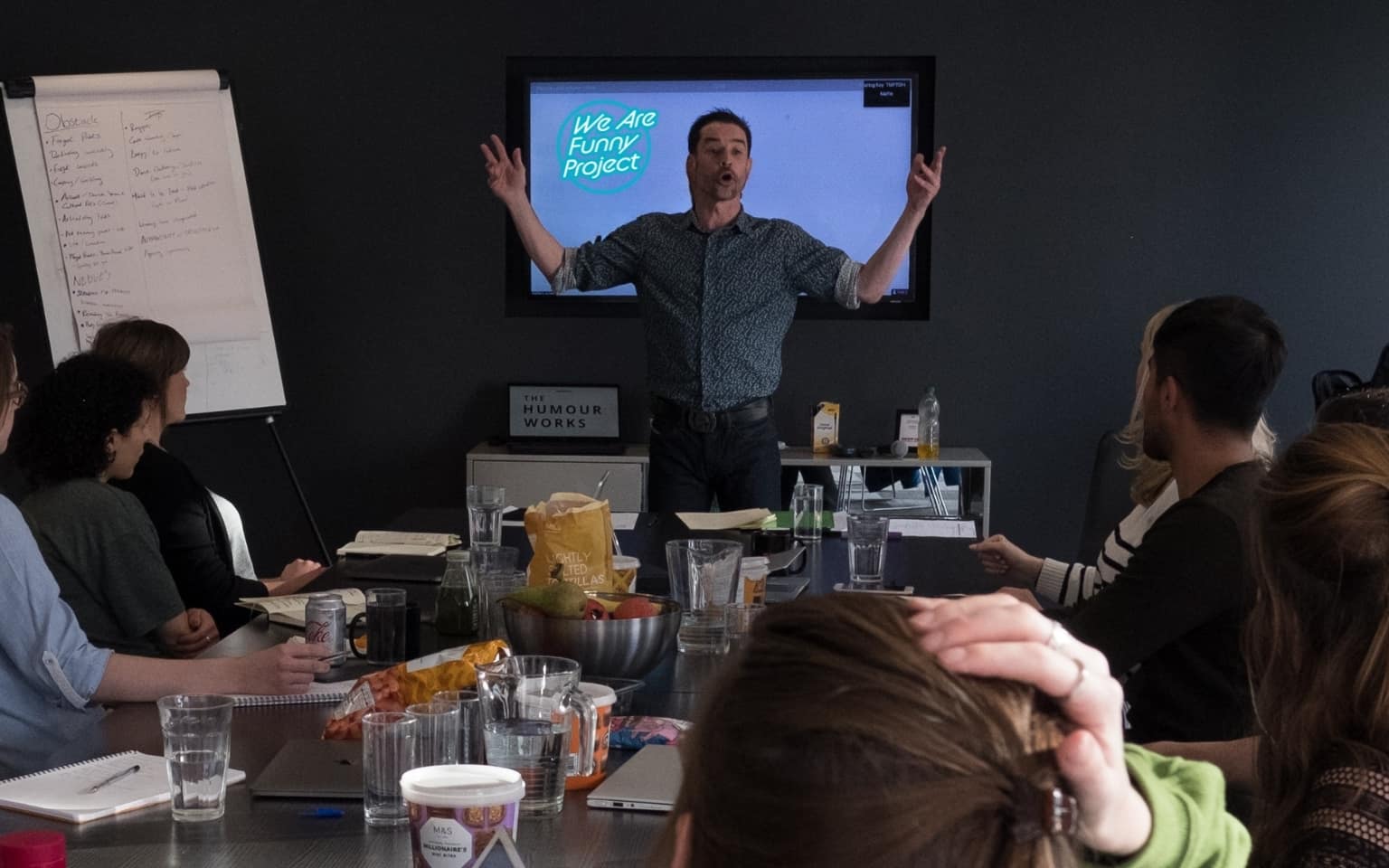
There's a reason I've avoided the word "levity" in this title, even though it's in the name of one of my own workshops, The Levity Works.
Levity is a certain lightness or playfulness. Levity sounds like something you're allowed, a permission slip, a nice-to-have once the real work is done. What the research actually shows is closer to the opposite.
Let me be clear about what this isn't first, because it matters as much as what it is. These are not lessons in how to be funny. Nobody leaves one of my workshops as a comedian.
What they leave with is a process, the same one that stand-up comedians can run on, stripped down and applied to a completely different audience. Because underneath all the material, all the nights on stage, the skills of a stand-up comedian really only ever break into two disciplines.
Generating the material, and delivering it.
The writing and the creativity versus the presentation, the pitch, the public speaking.
Everything a comedian does sits in one of those two categories, and so does almost everything a business, a team, or a person speaking one to many, a room of clients or colleagues, has to get right.
Should people also pick up a few more laughs than they'd expect from a typical L&D session, along with a sharper sense of their own communication, that's fantastic. But it's a side effect, not the objective, whichever of my workshops they choose.
Building the Material:
Developing Stronger Ideas
Alice Isen's research on creativity is still among the most cited in the field. She found something that sounds almost too simple to be true.
People who'd just watched a few minutes of a comedy film solved a classic creativity test at three times the rate of people who hadn't.
The specific trigger mattered less than the mild, safe lift in mood it created, which loosened the grip of the first, most obvious answer and made room for the second or third one, the one actually worth keeping.
Every good comedian understands this instinctively. The first thought, the obvious one, rarely has the hook or the surprise that an audience needs, so the better ones always go deeper, usually by coming at it from an unusual angle first.
Everything else builds up from there. This isn't "be more creative," which nobody can act on directly.
It's a repeatable process. Finding that unusual premise, mining it properly rather than settling for the first pass, editing it down efficiently, then building it back up with fewer, better words, ideally with a hook that earns attention quickly and a finish that leaves them wanting more.
That process, blank page through to something worth saying out loud, is the focus of Developing Stronger Ideas.
Delivering It:
Confident Client Engagement
Giuseppina Scotto di Carlo is a language and linguistics researcher, and while studying TED talks identified three mechanisms doing the work when a room properly engages with a speaker.
Surprise, a fundamental of stand-up. A shared sense of superiority over the setup. And release, the tension of a moment finally breaking, usually where the delight lands. In stand-up, that would be the laughter response.
None of this strictly requires a joke, but a version of setup and payoff nearly always sits underneath. Comedians are going for 'ha ha', but for non-stand-ups, 'aha' is the more potent goal.
What all three require is noticing what a room is feeling and giving it somewhere to go, which is most of what reading a room actually is. Leading one is the same skill run in reverse.
There is a technique underneath a lot of this, prepared spontaneity, which sounds like a contradiction and isn't. It's one of the most reliable ways to come across as quick-witted and present in the moment, when what's actually happening is that you're simply better prepared than almost everyone else.
This technique is teachable, repeatable and highly effective.
Nerves before presenting to a room are entirely normal.
Public speaking terrifies most people. Building fast rapport changes the effect of everything that follows. Reading, and leading, a room through savvy use of body language is a powerful art and science.
Knowing how to adjust mid-flow and leave on a high rather than trailing off is the ideal.
These skills and objectives are addressed in Confident Client Engagement.
Staying Standing: Bomb Proof, Sales Resilience Under Pressure
Rod Martin, Professor Emeritus of Psychology at the University of Western Ontario and the researcher behind the Humor Styles Questionnaire, the standard measure used across the field, draws a distinction most workplace advice flattens.
Not all humour helps under pressure. There's humour and there's inappropriate humour, and knowing which is which matters everywhere.
What Martin calls coping humour, using it deliberately to reframe a hard moment rather than avoid it, sometimes closer to what people call gallows humour, is linked to lower stress and better psychological adjustment over time. A separate study of firefighters found this kind of coping humour measurably buffered the psychological impact of traumatic incidents on the job.
Resilience gets taught as a mindset, grit, positive thinking, push through. Yet what holds up under pressure is more specific.
How you set yourself up before a potentially hard call.
What you actually do mid-call when it's going wrong, smartly checking in with yourself rather than white-knuckling it.
Then of course, there's what you do afterwards, assessing and catching a breath, so that negatives of the last call don't bleed into the blank canvas that is the next call.
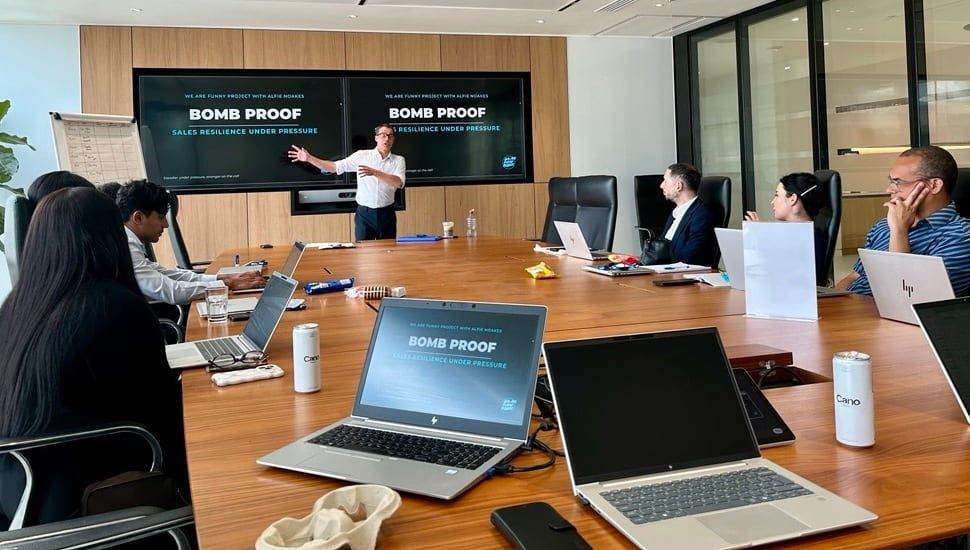
Prepared before, aware during, reflective after. That's the entire spine of Bomb Proof: Sales Resilience Under Pressure.
The Everyday Version:
The Levity Works
Naomi Bagdonas, who lectures on humour at Stanford's Graduate School of Business, co-wrote the terrific "Humor, Seriously" with Jennifer Aaker, on using levity and playfulness deliberately at work.
Between them they make a distinction worth repeating to anyone nervous about this subject. We can do serious things without taking ourselves too seriously.
If in doubt, remember that a joke in a professional setting is almost always safer aimed at your own expense than someone else's.
Appropriate use matters more than the joke itself. Besides, being appropriately self-deprecating has a charm unto itself.
A 2024 Deakin University study adds the necessary caveat. Used well, humour signals confidence and can be developed as a skill.
Used badly, it signals the opposite.
The objective in the professional world of whatever business you're in is rarely to elicit a room full of laughter.
If laughter is marked out of ten, with ten being the funniest, then stand-ups routinely chase those ever-so-hard to achieve eights, nines and tens.
In a workplace, you're aiming for the far easier twos and threes. Enough to raise a genuine smile, perhaps a small chuckle, to juice the social contract. There's immense value in being seen to warmly respond to humour, almost as much as there is in being the one bold enough to have a go at being amusing.
That's what bonds a team, makes a workplace healthier, and builds resilience for when harder times come. It's the ambient version of everything above, a warmer baseline running through how a team talks to each other and how they come across to clients and prospects as a matter of happier routine.
That ongoing shift is what The Levity Works is all about.
The Room Bonds Faster Than You'd Expect: Laugh and Learn Away Days
David Glew and Jessica Mesmer-Magnus of UNC Wilmington ran a meta-analysis pulling together a large body of workplace humour research.
It found a consistent pattern: shared humour correlates with stronger workgroup cohesion and better coping effectiveness.
NASA ran a stranger version of the same test, tracking small teams confined together for up to forty-five days in a simulated isolation environment, and found the same pattern held, positive humour increased how much team members trusted and liked each other.
An away day with genuinely more laughs in it than the average training day, and none of the usual trust falls or forced icebreakers, brings added bonding as an intentional effect on top of the actual lessons earned.
It's the shared experience of a room learning, together, how to be more playful, and how to welcome that playfulness in each other, that enhances the learning and development experience.
You can learn more about the option of standalone, bespoke stand-up comedy shows for your organisation here.
Naturally, we also provide the option of including a professional photographer, to take portrait photos of your team and the whole crew together.
That's the case for Laugh and Learn Away Days, whether that's a full training day at a genuine live comedy venue, a bespoke comedy show on its own, or both together.
Where This Leaves You
Four workshops. Bomb Proof, Confident Client Engagement, and Developing Stronger Ideas are built for anyone dealing with people outside the company as much as within it.
The Levity Works turns the same principles inward, onto everyday internal culture.
Underneath all four sits the same two stand-up disciplines, generating the material, and delivering it.
In more than a thousand nights MCing live stand-up shows and over a hundred group workshops since, I've watched versions of these claims play out long before I had top-tier academic research to back it up.
Stanford, Wharton, Deakin and NASA's own human research programme have since caught up with them independently, different fields, different methods, same conclusion.
Little of this is really about being funny. It is, however, based on the hard-earned insights, processes and methodology learned from the stand-up comedy stage.
It's about what happens to genuinely capable people once a room starts watching them, and making sure what the room sees matches what they can actually do, ideally with a smile, or at least a chuckle and some genuine appreciation for the effort.
And in a world of increasingly impressive, ever-emergent AI, it's worth holding onto what none of it can actually do. Spot the wonky, off-kilter pattern nobody else could see coming, delivered with a warm and satisfying pay-off.
Look someone in the eye and mean it. Share the small human signals that tell another person you actually see them. Share a laugh, a smile, recognise a genuine common interest, and build on it.
These are not merely soft skills apologetically sitting alongside the harder ones. These skills may very well be the ones that matter most.
If you want to see how any of this turns into an actual event with your team, have a look at what we do.
People also ask
Do these workshops teach people how to be funny?
No. They teach the two underlying disciplines of stand-up comedy, developing material and delivering it, applied directly to business skills. Being a little funnier is a common side effect, not the goal.
Which workshop is right if my team struggles with confidence in client meetings?
Confident Client Engagement is built specifically around presence, rapport and reading a room under pressure, the delivery side of the two disciplines.
Is there research behind using humour and playfulness in learning and development?
Yes, spanning organisational psychology, creativity research and leadership studies, from institutions including Stanford, Wharton, Deakin University and NASA's own human research programme.
What's the difference between an away day and a Levity Works workshop?
An away day is a single, memorable shared experience built around a live comedy show, ideal for team bonding. The Levity Works is about building an ongoing, everyday habit of workplace playfulness rather than one event.
Online classes for comedians at every level of experience
For business teams
For stand-up comedians
Stand-up skill set. Stand-out results
We teach the craft of stand-up because it is the most demanding communication training in the world.
No script to hide behind. No slide to point at.
Just you, a room and the immediate, honest feedback of a live audience.
That is what we teach. In different rooms, for different reasons, to different people.
We Are Funny Project Limited, 61 Bridge Street, Kington, HR5 3DJ, is registered in England and Wales, company number 08537398.
Copyright © We Are Funny Project Limited. All rights reserved.