
Rejection, Recovery, Repeat: What Stand-Up Comedy Teaches Sales Teams About Resilience
Everyone who has ever done outbound sales, at least a few times, has had a terrible day.
Indeed, they have all had lots of terrible days.
It comes with the territory.
There is, of course, a difference between a bad day and a catastrophic one. And a difference again between a bad day and a bad patch. Most people know this in theory. Under sustained pressure, the distinction evaporates rather quickly.
Stand-up comedians know this problem well.
There is a technical term for what happens on stage when no one laughs
It is called Dying on your Bootie.
You can picture it. The punchline arrives. The room doesn't even seem to notice. Someone coughs. A chair scrapes. Silence echoes. It is embarrassing, disappointing, and frankly quite horrible.
This has a sales equivalent. Seven outbound calls. Not one has gone anywhere. The opener that was converting in January is drawing polite silence in March. Somewhere around call four or five, something shifts. Not just the mood. The posture. The pace. The quiet but growing suspicion that the next one won't be any different.
That shift has a name, though you rarely encounter it in resilience training.
Emotional stacking.
One bad call is just a bad call. Eleven of them, back to back, across a week, with the same rejection landing in slightly different words each time? That's something else entirely. And treating them as the same problem, with the same solution, is where most resilience training falls down.
The bit where I tell you comedians have it worse. Bear with me
Please, humour me here.
Stand-up comedy has the fastest, most unambiguous feedback loop in all of public speaking.
Every set-up is an offer. Every punchline is a shot at closing.
It's all very public. Immediate. No softened debrief. No kind email an hour later. No "great effort, let's discuss in the one-to-one." Just silence, or worse, the wrong kind of laughter (and there are genres of laughter as much as there genres of movies.)
And the committed comedian will soon return to the stage, regardless of the success/failure of their last set.
It would be glib to suggest they simply shake failure off. Telling someone to shake off embarrassment, disappointment, and frustration is not a strategy. It doesn't account for the fact that these are real emotions in a real person. Acknowledging them isn't weakness. Pretending they don't exist is where things start to compound, emotions don't disappear just because they're being ignored.
They stack.
A laughter-free set leaves a performer feeling very alone. A second quiet one starts to feel like a pattern. By the fifth, material that has been written, rehearsed, and performed dozens of times begins to feel unconvincing. Not because anything in the material changed.
It's because the emotional weight of repeated rejection changes how it's delivered. The timing slips. The conviction underneath the words goes. The audience, who had nothing to do with any of the performance, gets a version of the performer that isn't quite the real one.
Chris Rock said something about this
Not about sales. About comedy. But the thought translates rather well.
"You bombed? Good. You've just bought data."
There is always more to learn from a gig that went badly than one that went well. Always. The smooth shows confirm what's already working. The disasters show where the cracks are. The job is to look at those cracks without flinching and without catastrophising, which is a harder discipline than it sounds.
The serious comedian reviews a bad set. Not in a spiral. Not defensively. Dispassionately.
What actually went wrong?
Was the opener weak enough to damage everything that followed? Was the punchline buried under too many words?
Was the energy off?
Did the performer have the slight air of someone who would rather be anywhere else?
In sales: did the opening come across as a script?
Was there a moment where the energy shifted and didn't recover? Was the close too early, too hesitant, or telegraphed from three sentences out?
Problems identified. Some diligent work means improvements are coming.
This is the pivot. Not a dramatic transformation overnight, but a gradual turning of the tide. More of what works. Less of what doesn't. Applied consistently, over time, the ratio shifts. More good calls. Fewer car crashes. Not because the job got easier, but because the data got used.
The hard one. Separating identity from outcome
A bad set does not make a comedian a bad comedian.
A bad week does not make a salesperson a bad salesperson.
The brain, under sustained pressure, struggles to hold that distinction. What happens instead is that identity fuses with outcome.
The bad call stops being a bad call and becomes evidence of something more permanent. Once that fusion happens, the next call carries it. And the one after that.
Stand-up forces this separation, night after night, on a stage in front of strangers, with no one to share the responsibility. The lesson, properly absorbed, is blunt and useful.
You are never your last call.
Millican's Law
There is a principle in comedy attributed to the brilliant British comedian Sarah Millican.
The essence of it: regardless of how the gig went, by 11am the following morning, let the associated feelings go. Good or bad. The reward or the punishment, whatever the emotions brought. The lesson will have been observed. Wipe the slate clean. Prepare to be better on the next one.
Consider that stand-up is a late night activity, and the timing can shift some. If one gets home after midnight, following the gig, then 11am is about right. However, if one knocks off at 5pm, well, maybe the reset can be set for no later than the point of waking up the following day.
The beauty of this 'law' is that it works in both directions. It limits the negative spiral after a rough night. It also, rather helpfully, reins in the ego after a brilliant one.
For sales teams, this is a reset tool with an actual deadline. Not "move on when you feel ready." Move on by the next wakey-wakey time. At latest.
Where most resilience training falls short
Generic positivity does not hold up under sustained pressure.
It offers a short-term mood improvement with no structural support underneath. When the pressure returns, and it will, there is nothing to fall back on. What gets described as resilience in a lot of corporate training is closer to optimism dressed in workwear.
Optimism is not a strategy for a high-rejection environment.
Most training teaches what to say. It rarely teaches how to recover when things go wrong. There's a significant difference between the two, and the gap between them is exactly where people unravel.
The Bomb Proof: Sales Resilience Under Pressure workshop was built for that gap. Practical tools for managing the emotional weight of a bad patch. Tools for the dispassionate review. For the reset. For separating identity from outcome. For distinguishing a single rough call from a sustained rough run, and for handling both with something more durable than a motivational poster.
Practical tools. Not motivational wallpaper.
The workshop is designed for any team where repeated rejection is a structural feature of the role. Outbound sales. New business development. Account teams facing attrition. Anywhere the job requires sustained performance after setbacks, which is to say, most roles worth doing.
One last thing
You'll never hear one comedian ask another to tell them about their best gig.
They only want the humbling horror stories.
That's not masochism. It may be a little schadenfreude, though. It's also wisdom about where the learning actually lives. Smooth shows confirm what's working. Disasters reveal what needs fixing. It is why Alfie Noakes wrote a whole piece on how to handle a bad stand-up gig - the process transfers directly. And they build something else too, over time.
Psychological armour.
Not a shield against failure. Something better than that. The steady, accumulated confidence of someone who has been through the bad patch before, used it as data, turned the tide, and come out the other side knowing that it can be done again.
There is no such thing as a truly worthless gig.
At very worst, it can be used as an example of what not to do.
Same goes for the call where everything went wrong. Then one has to move on... to greater success.
If this has given you a useful picture of how stand-up thinking translates into sales performance, the workshop is where it becomes practical.
Bomb Proof: Sales Resilience Under Pressure is a live team workshop built for outbound sales teams, BDRs and anyone in a high-rejection environment.
If your team also needs to perform better in pitches and client rooms, Confident Client Engagement covers the delivery skills that decide how a room goes.
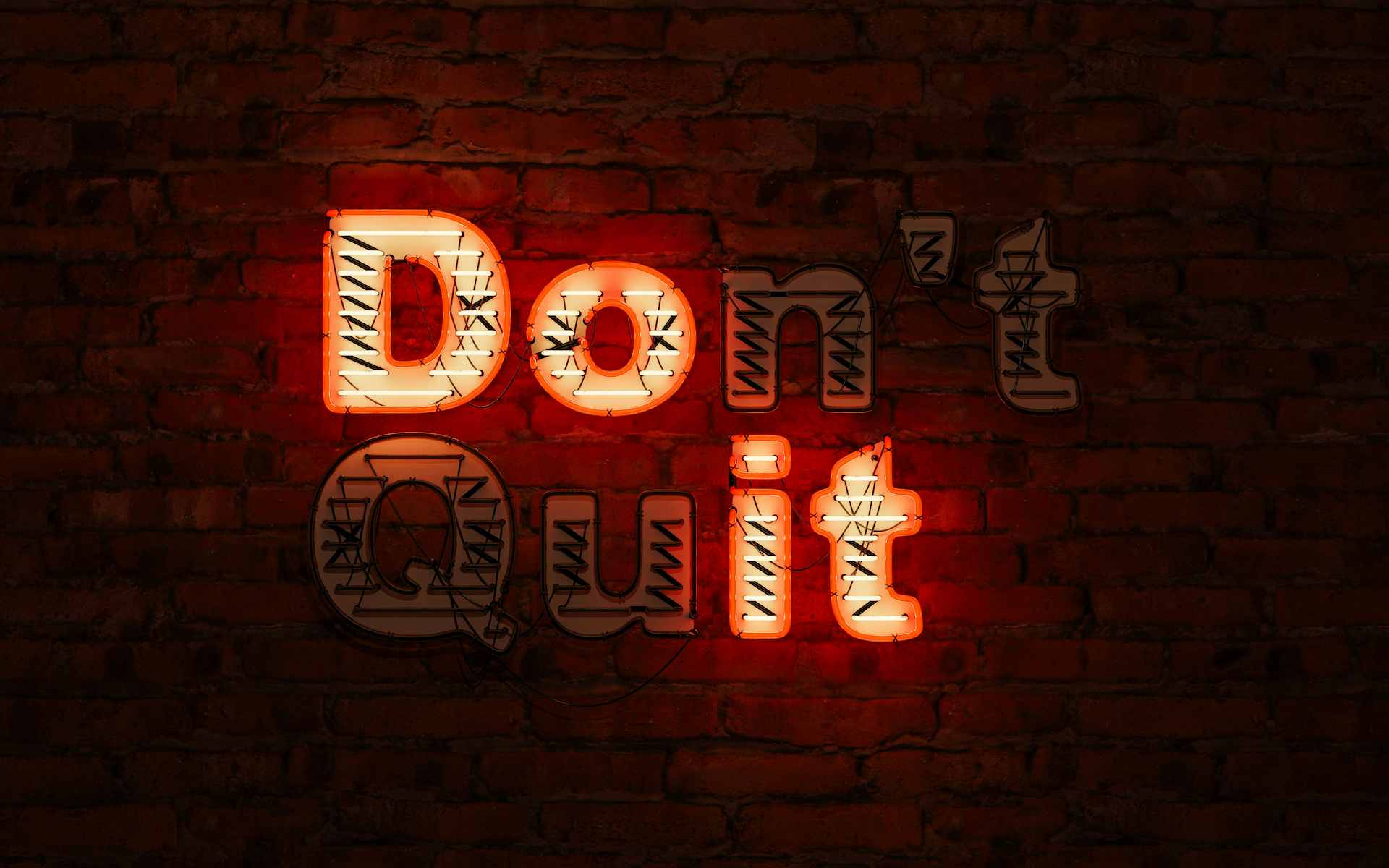
Header image 'Do It/Don'tQuit' by Behnam Mohsenzadeh via https://unsplash.com/@bmohsenzadeh
All other photos courtesy of Steve Best at www.stevebest.com
People Also Ask
Why does rejection feel worse when it keeps happening?
Repeated rejection triggers emotional stacking, where each new setback carries the weight of the previous ones. It is not the individual call that breaks performance, it is the accumulated emotional load that goes unprocessed. Addressing this is different from staying positive. It requires a structured way to separate identity from outcome.
What do stand-up comedians do after a bad gig?
The serious ones do a post mortem. They review what actually happened, separate what they can control from what they cannot, make specific adjustments, and return to the stage. They do not catastrophise and they do not pretend it went fine. They treat bad performances as data, because they are.
What is Millican's Law?
Millican's Law is a principle from British comedy, attributed to comedian Sarah Millican. It holds that by 11am the following day, regardless of how a performance went, the emotional response should be let go. The experience is logged, the lesson is absorbed, and the performer resets. Applied to sales, it provides a practical deadline for processing a bad call rather than carrying it forward indefinitely.
What is the difference between resilience training and psychological armour?
Most resilience training focuses on maintaining positivity and managing stress. Psychological armour is built differently. It comes from repeated exposure to failure, combined with a disciplined process for extracting the lesson and moving on. It is not a shield against failure but a proven ability to return from it, built through experience rather than mindset exercises.
Online classes for comedians at every level of experience
For business teams
For stand-up comedians
Stand-up skill set. Stand-out results
We teach the craft of stand-up because it is the most demanding communication training in the world.
No script to hide behind. No slide to point at.
Just you, a room and the immediate, honest feedback of a live audience.
That is what we teach. In different rooms, for different reasons, to different people.
We Are Funny Project Limited, 61 Bridge Street, Kington, HR5 3DJ, is registered in England and Wales, company number 08537398.
Copyright © We Are Funny Project Limited. All rights reserved.