Comedy Training For Business Teams: The Skills You Actually Learn
A company emailed me last month asking whether we did "games, like the trust falls kind." We don't. Never have.
That mix-up is common enough to be worth clearing up properly, because it says something real about how this space gets misunderstood. Say "comedy training for business" to most people and they picture forced fun. An away day with rope courses and a bag of props. Someone in a blazer trying too hard to make the sales director laugh at nine in the morning.
Nobody in these workshops learns to tell jokes, that's the other side of the business. What they learn is a specific set of skills that comedians build out of necessity, then I hand those skills over for use in a pitch, a client meeting, or a Monday morning stand-up that has nothing to do with stand-up. Though it's fair to say there's usually a bit more funny in these workshops than in most training sessions.
The Actual Skill Set
Here's what that list looks like in practice, because vague promises are easy to make and this shouldn't be one of them.
Generating ideas, then editing them down. Every comic starts with a rough, half-formed thought and works it through draft after draft until only the sharpest version survives. Plenty of teams already do something like this with a pitch or a strategy document. Fewer have been shown the genuinely efficient version, punching up material fast through a series of shortened drafts, rather than longer, less efficient, less evocative processes.
Reading the room you're in. Energy and attention can shift, not just mid-meeting, but even mid-sentence. Knowing when it's dropped, and adjusting before you've finished making your point rather than after, is a skill that gets trained, not inherited.
Establishing presence and rapport fast. A stand-up comedian gets one entrance and just a matter of seconds to establish themselves. Nobody in business gets much longer either, whatever they might tell themselves.
Handling curveballs. Every stand-up gets heckled, it's part of the job. What separates a good night from a bad one isn't avoiding the heckles, it's having a genuine response ready, staying sharp and appearing spontaneous rather than freezing.
Prepared spontaneity. The best off-the-cuff line on stage is rarely off the cuff. It's a response that's been built and tested in advance, then delivered as if it just occurred to you. That's a learnable technique, not a personality trait.
Pace, eye contact, and knowing when to stop. "Leave them wanting more" is an old showbiz line for a reason. Comedians know that overstaying a point can kill it, and overstaying a set can undo a good one entirely. Much business communication could stand to learn the same lesson.
Four Workshops, One Skill Set
That full list gets taught across four workshops, each built around a different business need.
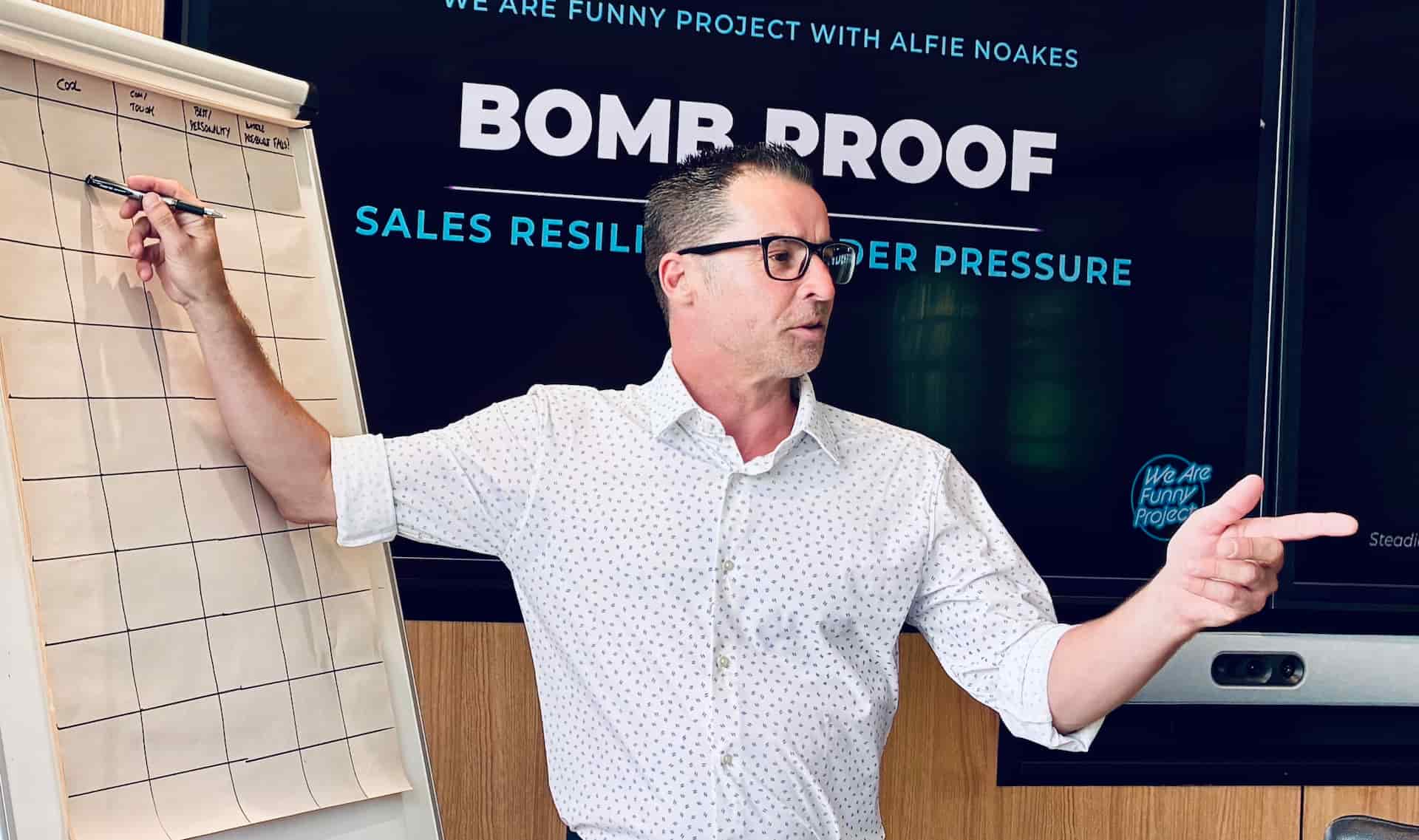
Every stand-up dies on stage, it's part of the job, especially in the early days. What separates the ones who last from the ones who don't is what happens in the preparation before, the execution during, and the honest analysis after, learning what worked, what didn't, and building on it before the next one.
Only the most resilient thrive and survive, whether that's on a stand-up stage or in one of the most demanding corners of business. Bomb Proof takes that recovery mechanism and hands it to sales teams who need to hear no and keep going.
A comedy premise starts as a fragment, then gets pulled apart, tested, and rebuilt until only the strongest version survives.
Developing Stronger Ideas teaches not just how to find a promising notion from a relevant observation, but how to use that same powerful editing and redrafting process, so ideas get built in their most evocative form, much faster than teams usually manage alone. You're probably doing fine already. This is about doing it very well.
Landing a joke and landing a pitch rely on the same thing, approaching the moment with real confidence and resilience, and being properly prepared for the set or the presentation.
Body language is an essential skill for life, for stand-up, for business, it's what shows you how to lead an audience and read an audience in real time, one of the many elements this workshop gets into. This is a workshop built for anyone who needs their delivery to work as hard as their content.
Not every workshop needs a stage-sized problem to solve. Sometimes the goal is simply a team that communicates with more warmth and less friction day to day. There's good science behind this too, teams that can smile and laugh together tend to handle hard times better and carry higher morale through them.
Nobody's being trained to become a stand-up comedian here. This is about the much lower-hanging fruit, the small, genuinely repeatable places a bit of playfulness can be injected into an ordinary working day, and exactly how to do it, whether or not you think of yourself as a particularly funny person. It isn't games. It's a real, lasting way to lift morale and resilience together.
Any of these four can also be run as a full away day, in a working comedy venue rather than a hired room. Some clients stop there. Others choose to end the day with a bespoke comedy show for the whole company, a genuine celebration, a Christmas party, whatever the occasion.
We work with you to choose the right comedians and can write material specifically for the day, your industry, your CEO, your culture, even, if you fancy it, a friendly dig at your fiercest competitor.
Why This Actually Works
None of this is guesswork. Across fifteen years in live comedy, I've watched roughly seven thousand performers work a room, more than five hundred of them on their very first gig, sharing stages along the way with acts like James Acaster, Sindhu Vee, and Stewart Lee.
I've MC'd more than a thousand of those shows myself, which means watching act after act up close, seeing exactly what worked and what didn't, and more often than not getting the chance afterwards to talk it through with them and learn from what they'd learned in turn.
I've had a front-row seat to nearly every mistake the newest comedians in the country have made and closely observed every flash of brilliance the finest professional performers have delivered. From the ridiculous to the sublime.
Independent research backs the same pattern up.
And it's not just theory for the people who've sat in the room.
People Also Ask
Does comedy training actually improve workplace performance?
The specific techniques, reading a room, editing an idea down and building it back up better, recovering swiftly from a stumble, transfer directly into meetings, pitches, and client conversations. It isn't about becoming funnier for its own sake, though if a few more laughs happen along the way, so much the better. This isn't about teaching people to be funny. It's about showing them how to tap into hard-won stand-up skills that are directly applicable in business.
Is this suitable for a serious or formal environment?
Yes. The workshops teach communication skills drawn from comedy technique, not comedy performance itself. Nobody's asked to tell jokes, and the material is shaped around your industry and audience.
What's the difference between this and a team building day?
Team building days are usually built around games and shared activity for morale. These workshops teach specific, transferable skills that people carry into their next meeting, and The Levity Works in particular is built around exactly that difference.
Can stand-up techniques really help with presentations or pitching?
Yes, more directly than most people expect, though presence alone isn't enough. A stand-up set doesn't survive on presence, pacing, and reading an audience alone, it depends on having real confidence in the material itself. Generating material you believe in, then delivering it with pace and the ability to read an audience's energy and attention, is exactly what a stand-up set and a client pitch both depend on.
How does humour help with leadership under pressure?
Used well, it signals confidence and composure rather than deflecting from a difficult moment. Used badly, it undermines credibility fast. The workshops teach the difference, and how to stay on the right side of it.
Online classes for comedians at every level of experience
For business teams
For stand-up comedians
Stand-up skill set. Stand-out results
We teach the craft of stand-up because it is the most demanding communication training in the world.
No script to hide behind. No slide to point at.
Just you, a room and the immediate, honest feedback of a live audience.
That is what we teach. In different rooms, for different reasons, to different people.
We Are Funny Project Limited, 61 Bridge Street, Kington, HR5 3DJ, is registered in England and Wales, company number 08537398.
Copyright © We Are Funny Project Limited. All rights reserved.