
What a Stand-Up Comedy Heckler Taught Me About Selling
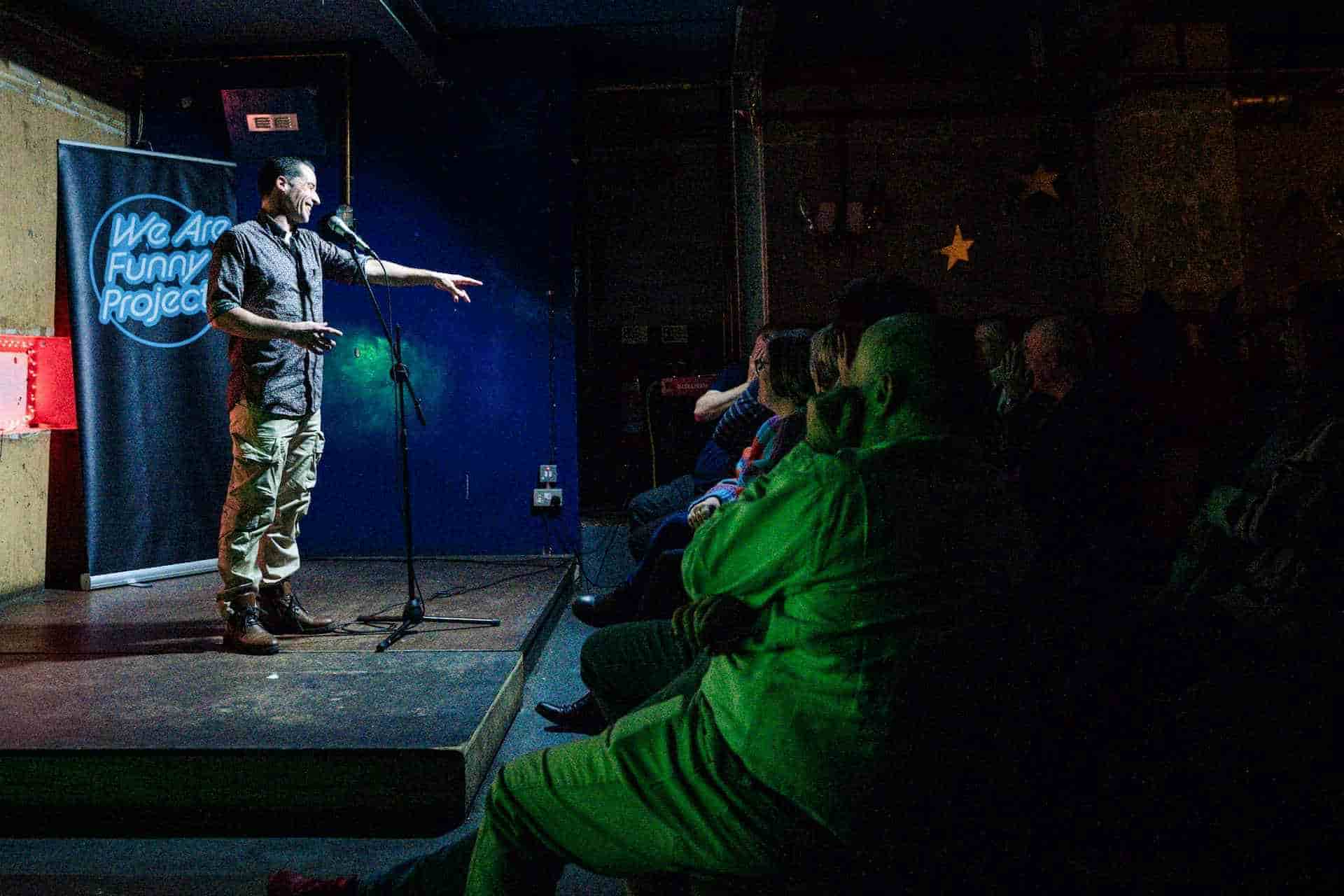
It was the Thursday before a bank holiday weekend, a good
few years back now. Dirty Dicks, Liverpool Street, a centuries old pub that looked
more like the inside of a pirate ship than the venue for a stand-up comedy
night.
The room was already loud and mostly full before I walked on stage as
the MC, to kick off the show.
Early on, one of the acts came off stage to something ugly
shouted from a table near the front. I came back on and did what I'd done a
hundred times before with anyone trying to disrupt a show. Singled him out. Mocked him and sealed the deal by inviting his companions to condemn him and subtly separate themselves from him.
Job done. Or so I thought.
What I hadn't clocked was that the heckler had roughly
twenty more friends in the room, scattered across four or five other tables,
not sat with him, not obviously with him at all. For the next while it stopped
being single heckler management and became something closer to a multi-front
battle in the form of verbal whack-a-mole. Put one down, another pops up three
tables over, a different face, a different angle, no pause between them to
catch my breath.
The phenomenon wasn’t just diverting the show; it was becoming the show. An MC must strive to keep the mood playful, the acts protected and the show running on track and on time.
It became pure us against them, and the us were a room full of decent people having a good time who loudly backed me, booed them. I wasn't fighting a heckler by that point. I was selling the room on siding with me to save their own evening.
Ultimately, by drawing on every trick in my back pocket and a few quality improvisations (even if I say so myself), the room energetically turned on the original mouth-breather and on every friend of his who'd piped up trying to back him.
Curiously, while I never encourage hecklers who simply
interrupt the craft of comedians, it all made for an even better night, more
memorable. No audience gets that kind of spectacle and energy through a screen.
Truly live. Entirely alive.
Funny Was the Word. Project Was the Point
A warm and portly man came over once the show wrapped. Sharply suited, clearly working in finance, probably somewhere on a trading floor a short walk from where we were
stood. He said something to the effect that anybody who could stay that
composed against that many people, keep the room laughing, and still be selling
the mood of the whole night by the end of it, was someone who could sell
anything.
He asked if I'd be interested in a conversation about a job.
I said no. Not because the compliment wasn't genuine. It clearly was. But because I wasn't looking for a job in finance. I called what I
was building the We Are Funny Project for a reason, and the operative word was 'Funny.'
'Project' was the critical word choice too.
It was always a project. It was always going to end up somewhere well beyond running live comedy shows and giving
grassroots acts their stage time, even if I couldn't have told you exactly
where it would go, on that Thursday night.
I Wasn't Selling Myself. I Was Selling a Fun Night and a Show
I've never been a comedian, not in the way people usually mean it. I was the promoter and the MC, which meant more stage time across an evening than anyone except the headliner.
At the time I was running four shows a week at Dirty Dicks alone and six a week across London, giving more stage time to open mic acts than anyone else in the country. Plus lots of spots for the pros and semi-pros stepping into headline slots.
I wrote topical jokes before most shows, tested them, cut what didn't earn its place, kept a running joke memory for the better part of fifteen years the way some people keep a diary.
That's worth being precise about, because "comedy skills for business" gets misheard easily. People picture improv games and trust falls, visions of forced funny and fake-laughing. That isn't even close to what I do.
I don't aim to teach anyone to be funny, not in a single day in a conference room. That's a different skill with a much longer time horizon. What I can do, reliably, is show almost anyone how to be a little funnier than they were yesterday. The transferable skills from stand-up run far beyond learning to be funny.
Underneath that headline skill sit a dozen smaller ones. Managing your own nerves. Finding a premise and working it up, then editing it down until only the strongest version survives. Rehearsing until it sounds unrehearsed.
On the night itself, it's establishing rapport fast, setting your status and persona from the first line, opening with a hook instead of a run-up, and reading a room while you're still talking to it.
And, of course, the old showbiz adage often applies, 'Leave them wanting more.'
Back to the chunky boss-man in the suit. Only a little of what he witnessed was purely improvised. He'd watched me hold a room, lean on prepared spontaneity, repeatedly adjust a plan in real time once the plan had stopped working, and keep developing new lines against fresh objections without losing the upbeat mood or the thread of the gig.
A great comedian, who had previously worked in sales, once told me, "My set up is the offer. The punchline is the close. If they laugh, then the deal is done, to everyone's satisfaction. If they don't laugh, it's an objection. So I need to pivot, work harder, try again."
Worth admitting though, since I'd rather be honest about it
than let the story sound too effortless: an MC works from a bag of tricks. Often leaning on prepared spontaneity, whether warmly chatting with the crowd or using lines that sound invented on the spot but
have been road-tested for years. A back pocket of steadily escalating put-downs
is another.
Here's a gentler version of the classic put-down, offered to someone shouting out at a gig, "You know this is my job? I don't come to your place of work
and tell you how to hold your mop, do I?"
And there are genuinely unique ripostes, Steve Martin's reply to a heckler shouting something dumb, "Aah, I remember my first
beer."
The brilliant Harry Hill, faced with something very rude yelled at him, came back with, "That
may be so, sir, but at least when I get home there'll be a freshly roasted
chicken waiting for me."
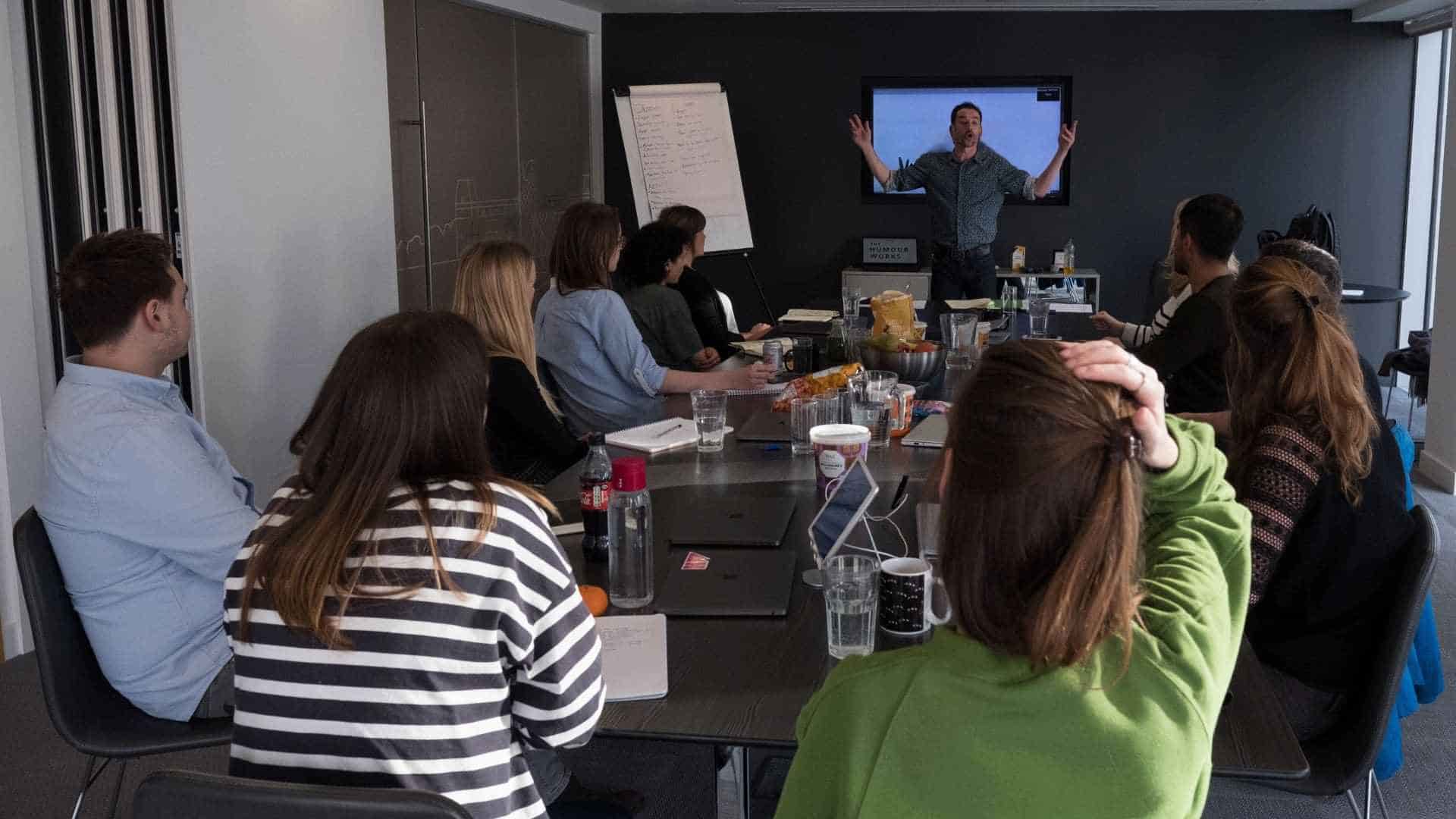
Original is wonderful. Prepared is powerful. Which is where the Confident Client Engagement and Developing Stronger Ideas workshops deliver the tips, tricks and transferable techniques.
The Room Doesn't Care About How Prepared You Feel
Charles Gruner, professor of speech communication at the
University of Georgia, spent his career studying what humour actually does to
an audience, and the honest finding isn't the one most speaker training
assumes. Humour barely moves how much information a room retains. What it
moves, reliably, is how the room rates the speaker. Gruner's studies found
audiences consistently rated a speaker higher on character once a joke had
landed, and in duller material, higher on authority too.
Barely any audience member at Dirty Dicks that night left remembering much of what I said. I named every act up onto the stage and off it again. I named the headliner more than once. I folded a few real opinions into the jokes along the way. But nobody left carrying facts. They left carrying the experience. They remembered how I held the room, while several people tried to take it off
me. How they felt during the skirmishes and beyond.
Reading a room accurately isn't a talent some people are
born with and others simply lack. Jeremy Yip and Rod Martin, psychology
researchers whose work on humour and social competence is widely cited, found
that how well someone manages their own emotions under pressure links to the
type of humour they reach for in that moment, self-enhancing and cheerful
rather than aggressive or defensive, though which one suits the room depends on
who's holding the mic.
Frankie Boyle and Mr Tumble are not selling the same
energy, and neither should be trying to. The comedians who prosper are the ones
who can read a room in real time and adjust. So are the client-facing teams who
last.
Why Landing a Joke Reads as Confidence
Researchers at Wharton and Harvard Business Schools, named Bitterly, Brooks and Schweitzer, found that successfully landing a joke increases a person's status in both new and
existing relationships, because it signals confidence and competence at the
same time.
Brooks put it plainly to the Harvard Gazette: taking the risk of telling a joke gets read as a powerful signal of confidence.
Schweitzer went further, arguing humour should be trained the same way any
other business skill gets trained, alongside a spreadsheet or a negotiation.
An element that is simultaneously under-appreciated and delightful is that landing the
joke isn't the only way to earn the credit. A colleague who hears a decent joke
and reacts accordingly, you know, chuckles or laughs, walks away with nearly as much social
capital as the one who uttered the joke in the first place. It's a small exchange between two people that is doing real work, bonding, tension
release, a small vote of confidence in each other that adds up over time into
genuine resilience.
I'll be frank about that night at Dirty Dicks rather than
tidy it up. I felt entirely confident dealing with the first heckler. I'd handled plenty before, and what he'd said was bad enough that the room was highly likely to back me. What actually rattled me was realising he had backup, spread
quietly around several tables, and that they weren't folding quickly.
That's
where my composure got truly tested, not at the start. Extensive academic research has concluded that the visible skill of looking assured might be closer to the trainable part than
actually feeling assured ever is. There are real techniques comedians use to
manage nerves before they even reach the mic, and most of them transfer
directly into business.
A Joke and a Pitch Die the Same Way
Dr Peter McGraw is a professor of Marketing and Psychology at the University of Colorado Boulder. He spent two years working on his book, The Humour Code, highlighting his conclusion of 'benign violation'. His follow-up book, Shtick to Business, applies his conclusions directly to the workplace.
My own concept, one of many, drawn from extremely close observation of more live comedy than 99.9% of the population, is simpler to state than it is to pull off. Surprise is key. Stronger if delivered with evocative language/imagery. (Anyone who claims to know the single recipe for being funny is deluded, a liar, or a deluded liar.)
"I stayed up all night playing poker with tarot cards.
I got a full house and four people died."
Steven Wright
"The depressing thing about tennis is that no matter how good I get, I’ll never be as good as a wall."
Mitch Hedberg
In these deliciously lean jokes we just don't see the twist coming. Which is one of my points. Surprise delights and engages. Laughter can do great work in preparing for a pitch. Alice Isen, a psychologist whose research on positive emotion and creativity remains one of the most cited in the field, found something close to absurd when you first hear it. People who'd just watched a few minutes of a comedy film solved a classic creativity test correctly three times as often as people who hadn't.
A small, safe jolt of amusement loosens the part of the brain that finds the unlikely answer. A half-formed pitch and a half-formed premise die the same way, too safe to surprise anyone, or too unstructured to actually make appropriate sense. The same is true of writing either: calibration is a key part of the process.
Locating the sweet spot between too much, and too little, for a joke or a presentation is the same skill, practised the same way, which is most of what I mean by Developing Stronger Ideas.
Jennifer Aaker, a marketing professor at Stanford, notes the physical side of this. Laughing together with someone floods the brain with the same hormones tied to love and connection.
It matters in practical terms. A room that's laughed together trusts you sooner, forgives you faster and remembers you longer than an audience that's simply been dryly addressed.
Almost Anyone Can Be a Little Funnier
Highlighting predictable scenarios as opportunities to inject a little playfulness and raise a smile is part of the mission.
Body language is a potent art/science, and is wonderful for reading and leading an audience of one, or many. Arguably the most powerful and universal element of non-verbal communication is quite simply to smile.
Any joke, or mere comment, told with a warm, open smile reads as coming from a
good place. The same line delivered flat can read as snide or backhanded, and
the room has to guess which one you meant.
There are the own-goal fake smiles. And then there are the sincere ones (that could still be faked, there's technique) that do so much heavy-lifting when it comes to connection and delivery. It's wise to know the difference and how to tap into the latter.
Sarcasm, in particular, is typically a self-defeating weak effort. It takes no wit to produce, and it's wide open to being
misread, especially in writing, where nobody can see the mitigating grin or chucklesome tone.
None of the workshops are about chasing the eights, nines and tens of hilarity that a
stand-up is hunting for under a spotlight. In a normal workplace they would almost certainly be counter-productive anyhow.
In business the target is
the twos, threes and fours, the small, warm, low-stakes attempt that gets a genuine smile rather than a laugh. Plus, there are pleasingly universal opportunities to apply straight-forward techniques for enhanced chuckling.
The Team That Laughs Together Performs Better, Years Later
Team behaviour researchers, Lehmann-Willenbrock and Allen, spent two years video-recording
fifty-four real teams in actual meetings, tracking not single jokes but the
recurring rhythm of joking and laughing that showed up meeting after meeting.
That pattern, not any one gag, predicted higher team performance both at the
time and still ongoing, two years later.
A separate review by Caroline Rosenberg and colleagues at
Deakin University put the same finding more plainly. Humour, used well, relieves tension, builds trust, lifts morale, and helps a leader form genuinely better relationships.
It's also, in
Rosenberg's own words, a double-edged sword, which is worth bearing in mind.
Poorly judged humour signals the opposite of everything above.
Well judged,
it's most of what separates a team that merely functions from one that actually
wants to be in the room together, operating at a higher and happier level. Increased morale and resilience are baked in.
A Negotiation Is a Pitch With More at Stake
The boss who offered me a job that night wasn't wrong about the qualities that he'd seen. He was just imagining aiming them at the wrong outcome. What he'd watched wasn't a trading floor skill, at least, not only.
Nobody bombs quite like a comedian. It happens in front of a room, in real time, with nowhere to hide, and you're straight back up the following night doing it again.
That's the exact muscle a sales team needs when a call goes badly and the next one starts imminently. The workshop Bomb Proof: Sales Resilience Under Pressure takes that experience and prepares you for managing what can happen before, during and after a knock-back is likely.
Taina Vuorela, a researcher who studies humour in business negotiation, found it easing tension in real client meetings and giving people a graceful way out when a moment went wrong.
Christine Gockel, who studies negotiation, names
the same effect plainly: the advantage of using humour that keeps you tough on the issue and soft on
the people across the table.
I was flattered by the interest from the boss-man, yet I turned him down because I was having a great time in stand-up and wasn't looking for a job in
finance.
More to the issue, I was already building this, the We Are Funny Project. If you want to see what lessons, learned up close and made memorable at thousands of stand-up gigs like that one, can actually turn into for a business team, have a look at what we do.
People also ask
Is this training the same as improv or comedy workshops?
No. These are business workshops built from stand-up and MC work specifically, finding and developing an idea, rehearsing and pitching it, reading a room, leading a room, body language, and building confidence before and during a high-stakes moment, taught as business skills rather than performance games.
Confidence under pressure, public speaking and presence, finding and developing a workable idea or pitch, reading a client or a room accurately, resilience after a knock-back, and building a team culture where people trust each other enough to speak up. Different workshops lean into different combinations of these.
Research from Wharton and Harvard found that successfully landing humour signals confidence and competence to a room regardless of how the person actually feels in the moment, which suggests the visible skill can be practised separately from the underlying feeling.
Online classes for comedians at every level of experience
For business teams
For stand-up comedians
Stand-up skill set. Stand-out results
We teach the craft of stand-up because it is the most demanding communication training in the world.
No script to hide behind. No slide to point at.
Just you, a room and the immediate, honest feedback of a live audience.
That is what we teach. In different rooms, for different reasons, to different people.
We Are Funny Project Limited, 61 Bridge Street, Kington, HR5 3DJ, is registered in England and Wales, company number 08537398.
Copyright © We Are Funny Project Limited. All rights reserved.