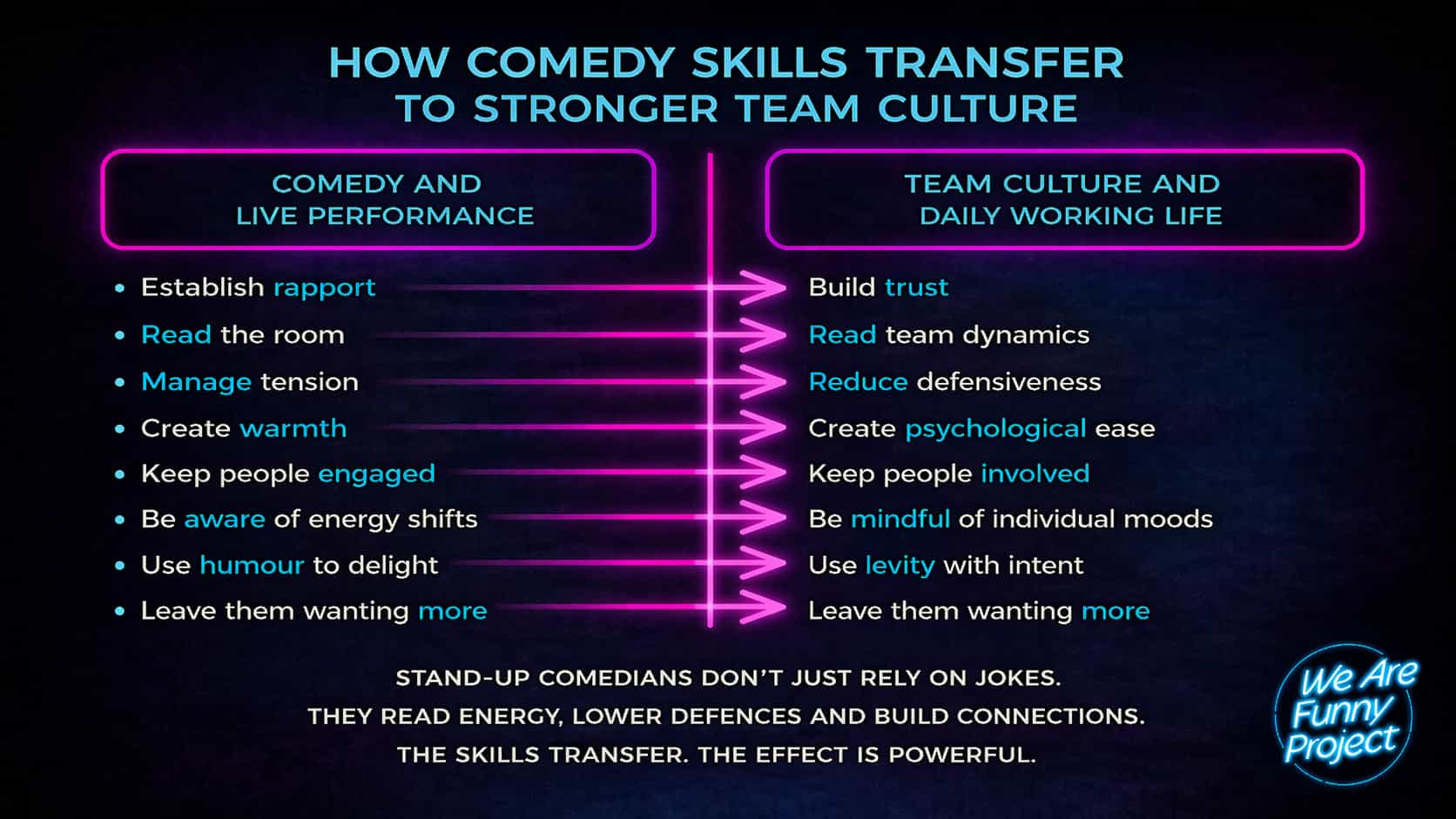
FOR LEADERSHIP TEAMS AND ANYONE WHO WANTS STRONGER CULTURE AND WARMER COMMUNICATION

The Levity Works

Warmth, connection and a little more humanity at work

A practical workshop for teams who want a happier, better connected and more resilient working culture, without the forced fun or the cringe team building


Especially relevant for: Chief People Officers, HR Directors, L&D Directors, senior leadership teams and anyone responsible for culture, morale and how teams communicate day to day

Why Work with Alfie Noakes

Alfie Noakes founded We Are Funny Project after more than 25 years across BBC journalism, television production and live comedy.

As a BBC journalist and documentary director, he spent over a decade learning how rooms work: how attention is held, how trust is built quickly and how the opening moments of any exchange shape everything that follows.

Across 1,800 live comedy shows, he had a front-row seat to something most people never get to observe at scale: what actually creates ease between a performer and a room full of strangers.

Not jokes alone. The timing. The small human moments that lower defences and make people feel genuinely at home.

He watched levity do things that seriousness simply cannot: dissolve tension, build trust faster, make people more willing to contribute, take risks and connect openly.

He also watched what happened when those qualities were absent. Rooms that stayed guarded. Teams that never quite gelled. Audiences that were present but never quite with you.

That understanding of what levity actually does, and how to use it intelligently rather than awkwardly, is the foundation of this workshop.

Why this workshop matters for your team

Most teams communicate well enough.
The ones that thrive do something different

When people feel at ease with each other they tend to speak up earlier, contribute honestly and handle friction without it festering.

Morale holds.

Collaboration feels less effortful.

Work becomes a little more human.

Most organisations know this in theory.
Fewer have a practical way to get there that does not feel contrived, forced or embarrassing.

There is also a reputational dimension that is easy to overlook.
Senior leaders who misjudge tone, lean on humour inappropriately or say something that goes badly in a room create real organisational risk.
Understanding where the line is, and how to stay confidently on the right side of it, is part of what this workshop addresses.


The route in is not mandatory fun or trust falls. It is intelligent levity, practical playfulness and a clearer understanding of where lightness can do genuine work in everyday professional life.


• Build a happier, more connected team culture

• Reduce defensiveness and increase openness

• Strengthen morale through everyday levity

• Create warmer communication internally and externally

• Support more resilient, more human working relationships


"Being a leader means handling stress. Better if you can do it with a sense of humour."

Barack Obama, Former President of the United States (But you knew that already, right?)

Why this approach makes sense

There is a significant difference between trying to be a comedian at work and using small, appropriate moments of levity to reduce tension, build rapport and create stronger bonds between people.

The aim is not ten out of ten hilarity.
It is the 2s, 3s and 4s: the smile, the chuckle, the warmer response, the more human exchange.
That is where a lot of the real value lives at work.

This workshop uses ideas drawn from stand-up, humour research and communication psychology to show teams where lightness can be applied usefully, safely and effectively in everyday working life.


"Leaders who use humour are perceived 23 percent more respectful, 25 percent more approachable and 17 percent more well-liked by their teams. Levity, used well, does not undermine authority. It signals it."

Aaker and Bagdonas, Humor Seriously, Stanford Graduate School of Business


"If you can laugh together, you can work together."

Bill Bailey, Stand-Up Comedian, Actor, Wild Musical Talent

'Humour, Seriously, book by' Aaker and Bagdonas,
Stanford Graduate School of Business

"The average four-year-old laughs around 300 times a day. It takes the average 40-year-old two and a half months to laugh that many times. Most professionals fall off 'the humour cliff' around the point they start taking work seriously. The research suggests that is exactly the wrong trade-off."

How Fun Are Your Meetings?
research finding, Vrije Universiteit

"Shared humour and laughter in real meetings predicted both immediate and later team performance. The effect was measurable and consistent."

Journal of Managerial Psychology

"A meta-analysis of 49 studies involving more than 8,500 participants found that positive humour enhances individual resilience, group cohesion and overall performance. Leaders who use humour effectively are seen as more motivating and approachable."

What your team will learn

Practical skills with immediate value

The Levity Works is designed to help teams bring more warmth, openness and ease into everyday working life.

Not through performance or forced jollity.
Through practical, learnable skills that make communication feel more human and work feel a little less heavy.

Where levity can be applied usefully

Learn where genuine opportunities exist for playfulness and lightness in everyday work, and how to use them without making things awkward or forced.

How to communicate with humanity

Develop practical ways to make written and spoken communication feel less transactional and more like it came from a real person.

How to build rapport quickly

Use small moments of levity and ease to strengthen bonds between colleagues, clients and teams from the very first interaction.

How to create safer, more open exchanges

Reduce defensiveness and help people contribute with greater honesty and less guardedness in meetings, workshops and everyday conversations.

How to bring ease into pressured environments

Use appropriate, light-touch humour to make work feel less heavy without losing focus, professionalism or credibility.

How to lead with more human authority

Understand how appropriate levity strengthens rather than undermines leadership presence, and how the most trusted leaders use it deliberately rather than by accident.

PSYCHOLOGY TODAY

"Employees who rated their leaders as having a sense of humour were more satisfied, more creative and performed at a higher level."

Sallie Krawcheck,
Time Magazine

"A sense of humour in business environments reduces hostility, relieves tension and improves morale."

'Humour, Seriously, book by' Aaker and Bagdonas,
Stanford Graduate School of Business

"A survey of more than 700 chief executives found that 98 percent prefer job candidates with a sense of humour, and 84 percent believe people with a sense of humour do better work."

What the session covers

The outline below reflects a strong baseline version of the half-day workshop.

The emphasis can shift depending on your team, your goals and the kinds of communication or culture challenges you want to improve.

In the full-day version there is more time for exercises, live examples, group work, brainstorming and direct feedback on what the team creates in the room.

Everyday levity with intent

What levity actually means, where it can be used and why small moments of lightness can have a meaningful and lasting effect on how a team feels and functions.

Appropriate humour and communication

How humour, playfulness and lightness can be applied safely and appropriately in written and spoken communication, without tipping into awkwardness or forced fun.

Ways to be more relatable

Practical approaches to making communication feel more open, more human and more memorable without trying too hard or losing credibility.

Practical applications across everyday communication

How to apply these skills across written and spoken interactions with colleagues, management and clients. 

Braver brainstorms

How a little permission, lightness and play can help teams contribute earlier, think more openly and generate ideas with less guardedness and self-censorship.
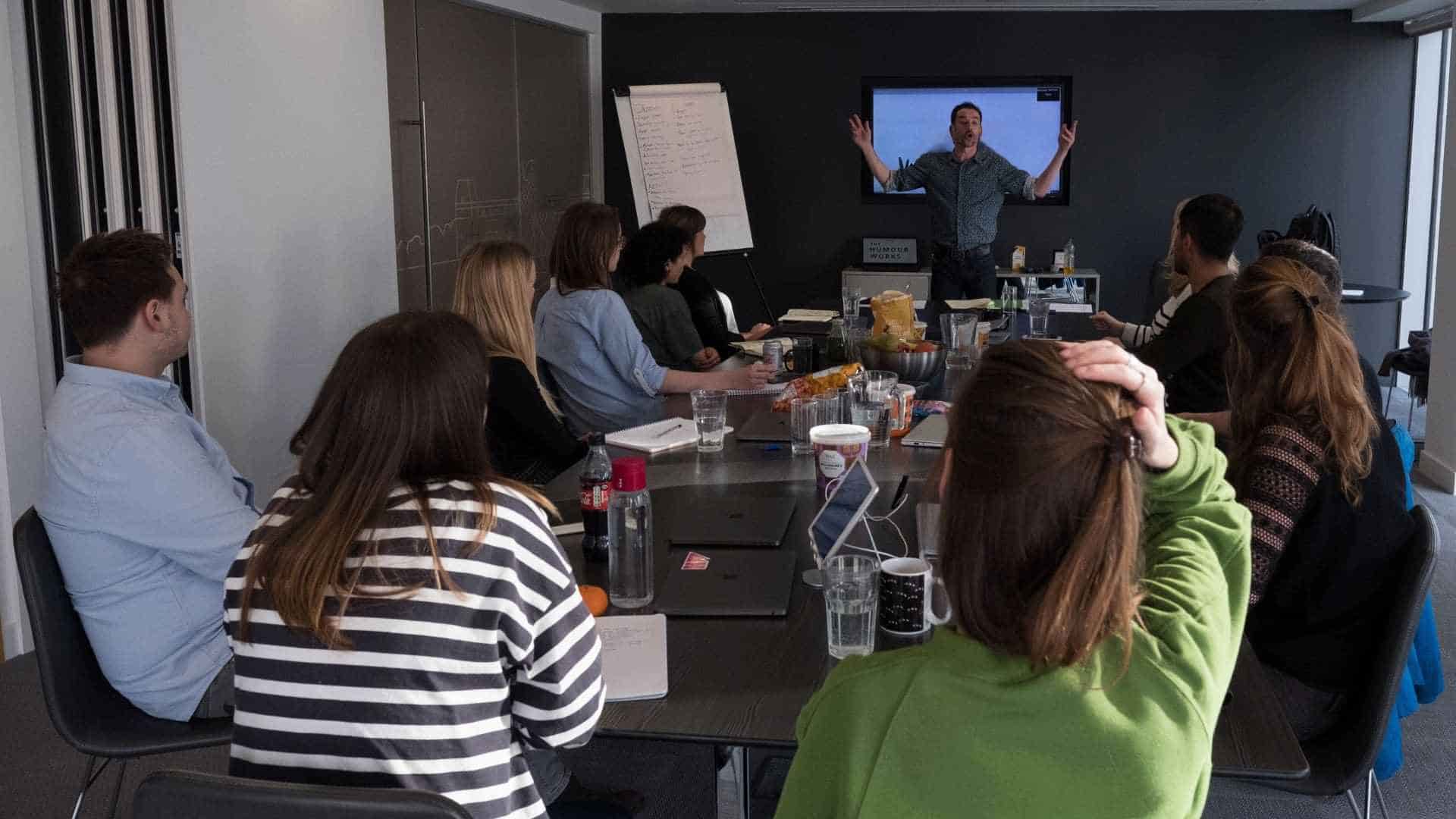
Take the workshop into a live comedy venue
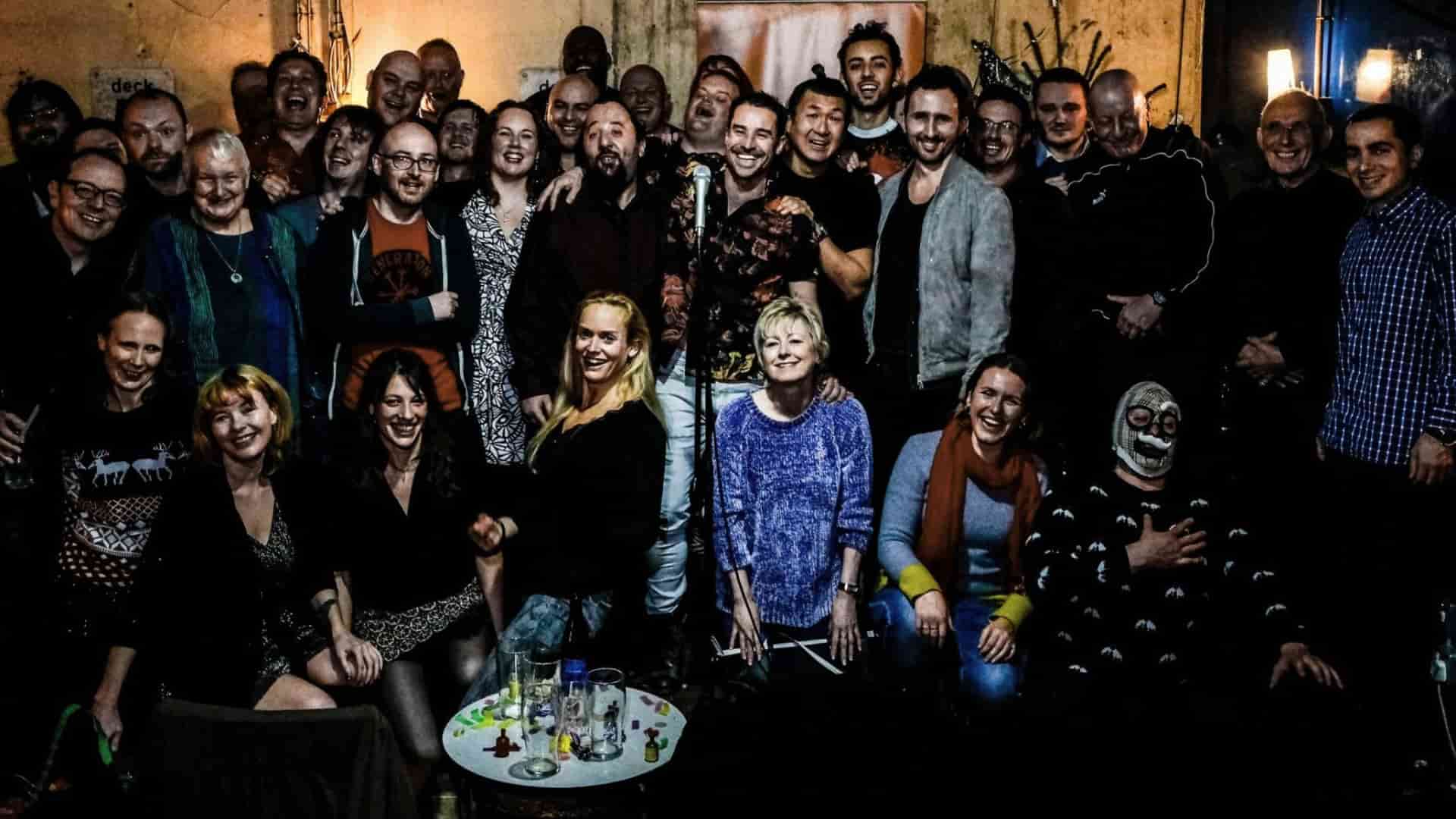
Choose a workshop in a working comedy venue, a private bespoke comedy show, or combine both into a day that develops your team and ends with something genuinely worth talking about.

Professional photographers can capture the whole occasion if you would like individual portraits, group and team shots taken.

Away day workshop

A full workshop delivered on a real stage in a working comedy venue. All the practical value of the core workshops, in a setting that makes the day feel genuinely different

Private comedy show

A one-off company event featuring professional comedians and bespoke material written around your people, your industry and your culture. The tone is agreed with you in advance

Combined experience

Workshop by day, unique stand-up show by night. Skills, shared laughter and one memory that will outlast any standard away day

Pricing and formats

Prices reflect a strong baseline version of the workshop.
Tailored content, travel outside London or additional coaching may affect the final fee.

All options include a pre-session conversation to shape the day around your team.

Relevant for Chief People Officers, HR Directors, L&D Directors, senior leadership teams and anyone responsible for culture, team morale and how people communicate day to day.

Half-day on-site
From £1,800

A focused, practical session delivered at your premises

Duration: 3 hours

Ideal group size: 8 to 10 people

Best for: a focused session on using levity, warmth and human connection to create a more open, energised and psychologically safe team culture

Style: interactive and practical with exercises drawn from comedy and performance that build genuine ease rather than forced fun

Result: people leave with a clearer understanding of how levity works, practical tools for warmer communication and a noticeably lighter team dynamic

Full-day on-site
Typically £3,000 to £3,500

More depth, more live practice and stronger behaviour change

Duration: 6.5 to 7 hours including breaks

Ideal group size: 8 to 10 people

Best for: teams who want deeper work on culture, trust and the specific communication habits that make rooms feel safer, warmer and more productive

Style: more room for team discussion, applied exercises, individual reflection and the kind of extended practice that makes behaviour change stick

Result: a team that communicates more openly, collaborates more effectively and brings a healthier energy to the working day on a consistent basis

Away-day in a live comedy venue
From £4,250

The full workshop delivered on a real stage in a working comedy venue

Duration: full day


Ideal group size: 8 to 10 people


Best for: teams who want the full TLW experience in a setting that demonstrates everything the workshop teaches from the moment they walk through the door


Style: same interactive format as the full-day, delivered on a stage in a venue where warmth, ease and human connection are built into the environment itself

Result: everything the full-day delivers, in a space that makes the whole premise of the workshop feel immediately and viscerally true


The away-day workshop is designed for your core team of 8 to 10. If you'd like to make more of the occasion, the evening is an opportunity to bring in a wider company audience for a private bespoke comedy show. Thirty, fifty or more people.

A natural extension of the day that turns a team workshop into a company event. Show pricing is by quote. Ask on the discovery call.


Not sure which format is right for your team?

Start with a 25-minute discovery call.

No hard sell. Just a focused conversation about your goals, your team size and which option makes the most sense.

Why this workshop works

Practical levity, not cheesy team building

The Levity Works is not about forcing fun into the workplace or trying to turn colleagues into entertainers.


It is about showing teams where lightness, playfulness and appropriate humour can genuinely improve the way people communicate, connect and work together.


When used well, these small shifts can reduce defensiveness, strengthen bonds, lift morale and make work feel more human without losing professionalism.


The goal is not chaos. It is warmth, openness and a stronger team culture.


"Treating humour as frivolous stifles creative expression in teams."

John Cleese, Legit Comedy Legend

Hannah gadsby
stand-up comedian

"A joke is a tiny revolution. It topples tension and lets trust walk in."

andrew carnegie
Industrialist, Philanthropist, Robber Baron*
(*Delete according to your perspective)

"There is little success where there is little laughter."

david ogilvy
"the father of modern advertising"

"The best ideas come as jokes. Make your thinking as funny as possible"

What people say about working with Alfie

Across workshops, gigs, one-to-one coaching and online courses, Alfie's work has attracted nearly 1,000 reviews with an average rating of 4.9 out of 5. No other communication trainer in this space has built that volume of verified feedback from real participants.
Alfie works subtly but effectively to shift behaviours, elevate performance, making the changes together and engaging the individual. A fantastic trainer. A true professional.
GORDANA,
Specialist, Accelerated Business and Cultural Transformation
Alfie has a beautiful energy that makes learning fun which means it sticks, so his workshops are always great value for money.
MAT,
Service Delivery Manager, Morse
Alfie provided a goldmine of practical tips in a clear structure. It helped me rethink my approach and bring more energy to my work.
WILLIAM,
MYSTERIOUS, YET BRILLIANT, FREELANCER

Explore more workshops

The Levity Works is one route into the work.

If your team needs something different, or something that complements this workshop, these may be a better fit.

Bomb Proof: Sales Resilience Under Pressure

For teams who need to handle rejection better, recover faster and stay steadier when difficult conversations are part of the job.

Best for: outbound sales teams, repeated objections, rejection-heavy roles and live communication under strain.

Confident Client Engagement

For teams who need to present more confidently, hold the room more effectively and communicate with greater authority in high-stakes moments. The skills that separate people who hold a room from those who merely occupy it.

Best for: pitches, presentations and client-facing delivery.

Developing Stronger Ideas

For teams who need sharper thinking, stronger development and better material before delivery even begins. The workshop that works on the idea before anyone has to stand up and present it.

Best for: idea generation, shaping material, sharper messaging and stronger creative thinking.

Ready to find out if The Levity Works is right for your team

Start with a 25-minute discovery call. No hard sell.

Just a focused conversation to work out whether this is the right kind of help and, if so, exactly what that looks like for your team.

Frequently asked questions

Do you offer ongoing coaching or longer programmes?

For teams who want more than a one-off session options include 1:1 coaching, repeat sessions and broader programmes shaped around ongoing communication and performance goals.

Best discussed on a discovery call.

Is this just a fun team-building session?

No.


It should be enjoyable, yes, but this is not fun for fun’s sake.


The workshop is designed to show teams how appropriate levity, humour and playfulness can strengthen morale, reduce defensiveness, improve connection and support a healthier working culture.

Is this still appropriate for serious or senior teams?

Yes.


In many ways, it is especially useful there.


The workshop is not about silliness or forced banter. It is about using appropriate levity and more human communication to strengthen trust, openness and morale, all of which matter just as much in serious environments as anywhere else.

What are the payment terms?

Our standard terms are 50 percent on booking and the balance within 14 days of delivery.

For larger organisations with established payment processes, we are happy to discuss terms that work for both sides. Just raise it on the discovery call.

Do you travel?

Yes.

Workshops are usually delivered in person, and travel can absolutely be discussed. 1:1 coaching is more appropriate for video conferencing.

For bookings outside London, additional travel costs may apply, and for longer-distance work, accommodation may also need to be covered.

All of that can be discussed clearly at discovery stage, before anything is confirmed.

Can the workshop be tailored to our team?

Yes.


The page outlines a strong baseline version of the workshop, but the emphasis can shift depending on your team, your culture and the kinds of communication or morale challenges you want to improve.


Some teams may want more focus on internal connection. Others may want more emphasis on client-facing communication, leadership tone or brainstorming.

What group size works best?

Workshops are typically designed for around 8 to 10 people to allow for real depth, practice and feedback.

Smaller groups allow for even more individual attention. Larger groups can still be accommodated, but the delivery may need to be adjusted to suit the format and goals.

Is this about teaching people to be funny?

No.


Nobody is being trained as a comedian, and the goal is absolutely not to turn the workplace into an open mic night.


This is about helping teams use lightness, warmth and appropriate playfulness more effectively in the way they communicate and work together.

Who is this workshop best suited to?

The Levity Works is designed for teams who want a happier, more connected and more resilient working culture.


It is especially well suited to Chief People Officers, HR and L&D teams, and senior leaders who understand that how a team communicates day to day is not a soft concern, it is a performance and retention issue.

Infrequently asked questions

What was the best-selling book in the world in the year the first text message was sent?

The first text message was sent on 3 December 1992. It read "Merry Christmas."

It was sent by engineer Neil Papworth to Vodafone director Richard Jarvis, who was at a company Christmas party and did not reply, presumably because mobile phones could not yet send texts back.

The best-selling book of 1992 was Scarlett by Alexandra Ripley, the authorised sequel to Gone with the Wind. It sold over 30 million copies worldwide.

What is the collective noun for a group of flamingos?

A flamboyance. If you see a gang of flamingos coming at you, then you are mistaken, not a gang. A flamboyance of flamingos would be coming for you. See?

Also, fyi, a group of crows is a murder. A group of owls is a parliament. A group of cats is a clowder. A group of starlings is a murmuration.

You can decide for yourself what a group of short and dehydrated Yorkshiremen should be called...

If Wile E Coyote's budget were real, what could he have bought instead?

A very comfortable early retirement and, in all likelihood, the Road Runner.

This requires establishing what Wile E Coyote actually spent. Across the original Warner Bros cartoon run from 1949 to 1966, the Coyote purchased products from the Acme Corporation in approximately 355 documented attempts to catch the Road Runner.

Products included rocket skates, earthquake pills, an Acme bat-man outfit, a dehydrated boulder, an Acme jet-propelled unicycle and, on one occasion, an Acme female Road Runner costume whose strategic logic remains unclear.

Acme products, being cartoon-grade specialist equipment, would carry significant commercial premiums. Conservative estimate per attempt: £3,000 including delivery, which Acme always provided with suspicious speed. Total expenditure across 355 attempts: approximately £1,065,000.

For £1,065,000 in 1950s money, adjusted to today's values at approximately £35 million, Wile E Coyote could have purchased: a substantial property in the American Southwest with a private road on which to corner the Road Runner legally, a team of professional wildlife consultants, several years of catering and, if the Road Runner remained elusive, a very pleasant life in which he simply ate something else.

The Road Runner, being a bird, is not technically purchasable. However a professional falconer with a trained pursuit bird and a reasonable budget could have resolved the matter in an afternoon.

The Acme Corporation's continued existence depends on customers not reaching this conclusion.

The evidence suggests their marketing is extremely effective.

Can I marry someone for their Tesco Clubcard points?

In the United Kingdom, no. Not legally. Not directly.

The Marriage Act 1949 sets out the grounds on which a marriage can be conducted and does not include Clubcard points among the recognised motivations, which is either an oversight or evidence that the legislators of 1949 were shopping somewhere else.

A marriage motivated entirely by loyalty scheme benefits would not, on those grounds alone, be considered void. English law does not require love as a precondition. It requires consent, capacity and the absence of certain prohibited degrees of relationship. Tesco does not appear in the prohibited list.

The practical complications begin after the ceremony.

Clubcard points are non-transferable between accounts under current Tesco terms and conditions. You cannot merge two Clubcard accounts upon marriage in the way you might merge finances or Netflix subscriptions.

What you can do is shop together, accumulate points jointly on a single card and present that card at the checkout as a household unit, which is essentially what most long-term relationships become anyway.

The points themselves are worth approximately one penny each when redeemed on Tesco shopping and approximately three pence each when converted to partner rewards such as restaurant vouchers or days out. A substantial Clubcard balance of, say, 50,000 points would be worth £500 in store or £1,500 in partner rewards.

Whether this constitutes sufficient grounds for a lifelong legal commitment is a question only you can answer, and frankly a question a good solicitor would prefer you answered before rather than after the ceremony.
Created with