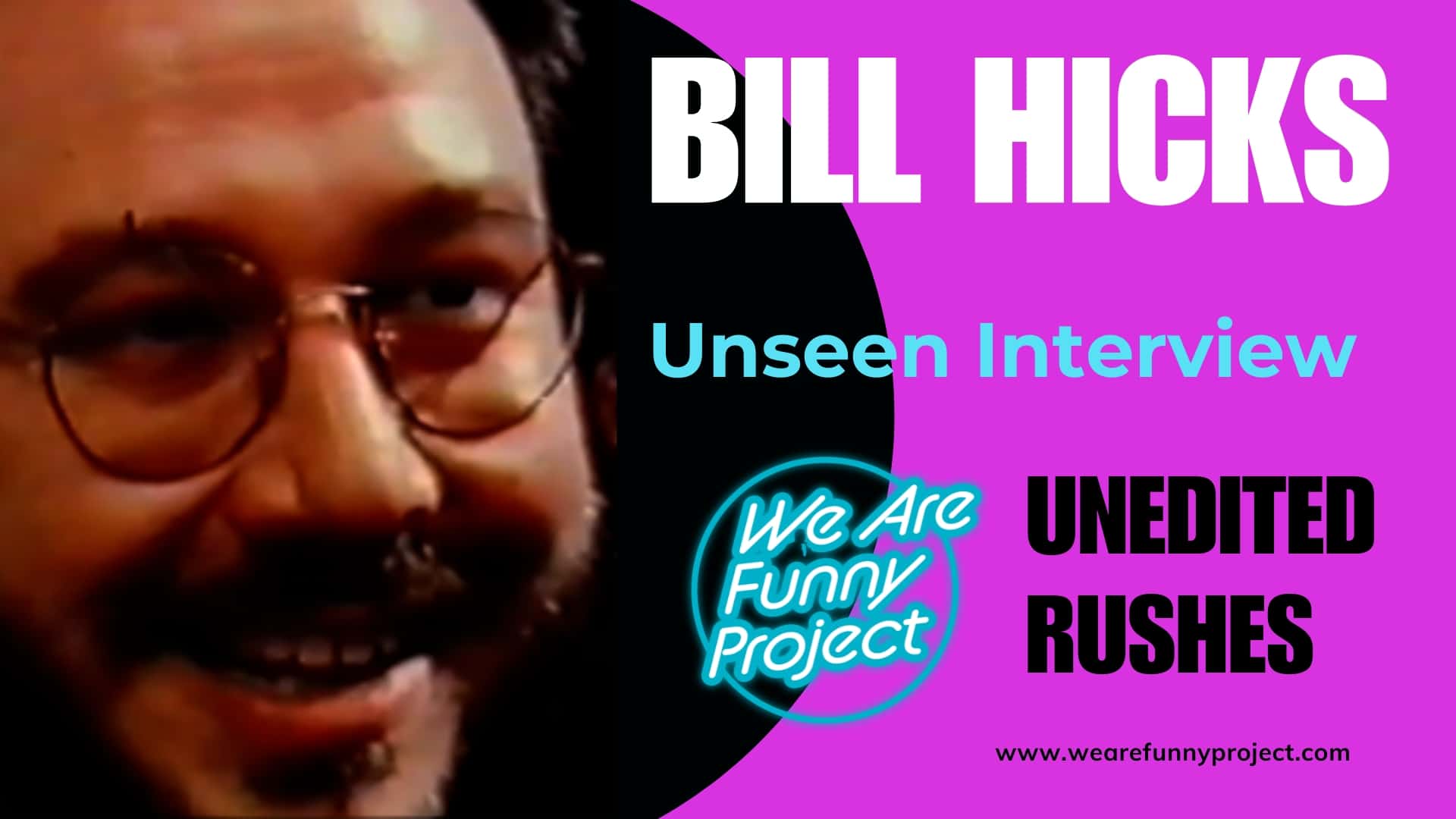
In the early 1990s, two apparent English television producers sat down with Bill Hicks in a bar after a gig in America. Hicks believed, it is thought, that he was being considered for a British television appearance.
What followed was never broadcast. What you are about to watch is the complete, unedited rushes from that interview. Twenty-two minutes of Bill Hicks, unfiltered, on camera, in a bar, talking about everything that mattered to him. Plus, some B-roll of him performing on stage.
I received this footage on VHS from a connected individual more than thirty years ago. During lockdown I uploaded it in four separate parts, poorly. It deserved considerably better than that. This is the full footage in a single clean video, exactly as it is.
If you are working on your own stand-up comedy, this is worth grabbing while you are here. The Eight Most Powerful Ways to Turbocharge Your Stand-Up Comedy is a free e-book, just updated for summer 2026. It covers the fastest ways to improve between gigs, develop stronger material, and get more from every stage you step on.
Across the interview, Hicks talks about television and censorship. About the absurdity of networks telling him his material is too graphic while their own commercials are more disturbing.
He names the people who made him: Bob Dylan, Jonathan Swift, Mark Twain, Lenny Bruce. He draws the distinction between anger and passion, and explains patiently why people consistently mistake one for the other when they look at him.
He talks about religion and the peculiar logic of a self-described Christian nation that bombs other countries. He talks about why he will not compromise his work, and what it would cost him if he did.
At one point, when one of the interviewers suggests they need to think for the audience, Hicks responds with a line about a chalice of goat blood. It is one of the most Bill Hicks things you will ever see him say on camera.
He also covers the Kennedy assassination and the Warren Commission, the Rodney King trial, his own position in comedy as somewhere between Benny Hill and Jonathan Swift, and his view that comedy and philosophy are not separate disciplines. At one point he says, simply, that he is not a comedian. He is Bill Hicks.
The footage was recorded around the time of the Gulf War under George Bush Sr. There is some brief stage performance material from the same period included at the end.
"Less funny, more fame. I don't think that's funny, though. I don't want all these people. I want just people who think."
Bill Hicks died on 26 February 1994. He was 32 years old. He has been talked about ever since in the same breath as Jimi Hendrix and Jim Morrison. For what he was, how briefly he was here, and what he left behind.
I was fortunate enough to see Bill perform live when I was a teenager. He was the most important comedian I ever saw. I have seen many of the all-time greats. None of them did what he did.
There is something particular about watching this interview knowing what we know now. He is sharp, funny, restless, impatient with stupidity and genuinely warm when the conversation finds its level. He is also, unmistakably, a man who knows exactly what he thinks and has absolutely no interest in adjusting it for anyone in the room.
If this interview does something for you, which it might, since it shows his authenticity and grace, here is some context on what made Hicks the comedian he was and why he is one of the most influential stand-ups of all time.
He talked about comedy as philosophy. Not as a cute comparison but as a genuine position. The job of the comedian, in his view, was not to make people comfortable. It was to show them what they already knew but had decided not to look at directly.
"I talk to the audience like I talk to my friends. They don't sit there and go, Bill, you're so controversial. They know that I'm having a conversation and we're talking about ideas, and there's no limits to the way we can express ourselves."
One of the things that strikes me every time I watch this footage is how contemporary he sounds. The specific targets have changed. The underlying absurdities he was pointing at have not. A comedian working today with the same instincts would find no shortage of material in exactly the same territory.
That is either a hopeful sign that the questions he was asking are timeless, or a less hopeful sign that not much has changed. Probably both.
What has changed is the landscape for comedians. The open mic circuit he came through, the television gatekeepers he was fighting, the idea that a comedian needed network approval to reach an audience: all of that is different now. The tools are different. The craft is not.
If you are developing your own stand-up and want to understand what separates a comedian who merely says things from one who means them, this interview is worth watching more than once.
Who was Bill Hicks?
Bill Hicks was an American stand-up comedian, satirist and social critic who performed from the late 1970s until his death in 1994. He is widely regarded as one of the most influential comedians of the twentieth century, known for his uncompromising material on politics, religion, media and consumerism. He died of pancreatic cancer aged 32. A genuine tragedy.
Why is Bill Hicks still so influential?
Hicks treated comedy as a form of philosophy rather than merely entertainment. His material was built around ideas rather than observations, and his targets were systemic rather than superficial. That approach has influenced generations of comedians and his work has aged unusually well because the underlying questions he was asking remain relevant.
What did Bill Hicks think about selling out and compromising?
Hicks was unequivocal on this. He believed that compromising his material for broader appeal or commercial opportunity would cost him the only thing that made the work worth doing. In this interview he puts it simply: less funny, more fame. He was not interested in the trade.
Where can I learn more about developing stand-up comedy?
We Are Funny Project offers online courses for comedians at every level, from first open mic to experienced performers looking to push their work further.