Like so many things in this world, superior outcomes are a result of a blend. Maximise your “best practise” and minimise the worst behaviours.
Want more available money? Well, earning more is one way.
Reducing spending is another. Increase the income and slash your costs and that’s your winning blend.
Want to lose weight? Do more exercise. Eat less sugary foods. And on and on… So what to do it you wish to be come more funny? Even a better stand-up?
As I write this, I am soon to wrap up bookings for the next month. Thus, I have some current stats to refer to. First, a little context…
Over the years We Are Funny Project has run at a variety of venues, with two especially long terms ones. Shows have been as thin-on-the-ground as a single gig a week or run as broadly as 6 weekly shows.
Currently, it’s two weekly shows and given my show format this equates to around 125 spots per month. That said, I do not have 125 open mic spots to conjur with and freely distribute.
Around 10 are pro and semi-pro headliners who are in their own separate arena when it comes to booking. A further 10 are acts who are getting a 10 minute “progression” spot. Again, putting the way I book them into a different category. Check out details on 'comedy profession' here.
Right away, we’re now talking about around 105 x 5 minute spots (this is in London, after all). Yet, I’m going to take off another 25 from that figure. There are a certain number of spots that I distribute to specific people. I make no secret of my willingness to show some degree of favouritism.
These 25 (or thereabouts) spots are given to students from the range of online courses, 1:1 coaching, or live workshops. These acts have actively invested in themselves and I wish to observe their development and bring some added value to their stand-up journey,
Others are simply good friends whom I love watching perform and hanging out with after the gig. There are the quality acts who are only available in London for a brief period from another city or country. Then there are specific recommendations from a trusted source for a “new face to check out”.
There are those who have a particular desire or need and ask a favour of me. They want to get especially well prepped for a TV spot, a competition, or whatever…
I have a firm desire to make sure no two shows are very similar. It's important to ensure the gig/job remains fun and fascinating for me and the audiences. It helps no one to see the same faces run the same material, over and over. That is a kind of comedy hell which I refuse to endure.
I have come to learn that many acts fear that I will not book them again if they have a bad set.
Nothing could be further from the truth. Comedians have the greatest chance of improving through stage time, lessons and effort. Most often there is more to learn from the failures anyway.
In the earlier years I came to think certain acts would never get to at least a tight five. I pretty much dismissed their potential but would still book them. I admired the tenacity and, typically, they were lovely off-stage.
Then, again and again, at some long future point they seemed to “crack it”, after even four or five years. More than a decade as an MC and booker has taught me to never dismiss the potential of any act. Well, there was one, but only one, OK there were two… still, not bad at all, from a cast of thousands.
As I write this blog, it is slightly less than 72 hours since I opened this latest round of bookings. I have received 212 requests. I have no doubt that if I kept the bookings window open for another 24 hours, applied a little bit of effort, that number would approach 300. I will close bookings in a few hours from time of writing.
Back to my earlier point, 212 requests. Let's allow a little overlap with the “Favouritism 25” and call it a straight 200.
200 requests for 80 spots. That suggests 120 people won’t get their wish this month. In most cases, it is no fault of the comedian requesting a gig. Alas, it's a simple matter of current supply and demand.
In other instances, the acts have provided me a reason(s) to jump past their request.
Now we have the numbers and agenda laid out. Here are some examples of “best practise” to maximise your chances of getting booked.
· Be reliable. Always turn up on time. Never over-run. Click “Going” on the event link in a timely fashion… these are efforts I rate and value and try to reward.
· Follow the simple booking process. I write most clearly in the bookings announcement. Acts should state in their email Subject line the date(s) they would like, along with the number of gigs they have done. Seems minor? Not so much when notating and wading through more than 200 requests. Those who can’t get this bit right go to the bottom of the pile. It’s a lot of work as it is… those who make the job easier are higher in the rankings of consideration.
· Be lovely. An honest kind word after the gig makes me more likely to remember a certain act brings positive energy. It makes me feel good and that's not bad. The same applies when I see a performer being kind to other acts. Lone-wolf as stand-up is, we are very much a community.
· Be persistent. If you don’t get a spot 1 month then try again next month and mention you tried before. I want to book pretty much everyone at some point. Polite persistence is admirable. I am sorry to not be able to accommodate everyone all the time.
· Be supportive. Sharing gig info on your social media or liking and sharing my promotional efforts is appreciated, perhaps leaving a lovely online review. It's not about sucking up, it's about being positive and noticeable.
Some performers have made excellent personal impressions such as offering to help pack away gear after the show, or some such kindness. I usually don’t accept the offer as I have my own myopic system, but it’s the thought that counts. And it does get counted.
Having accentuated the positive, let’s consider some of the behaviours best avoided. By and large, think of the opposites of the “best practise” list, above, and don’t do that.
Any of us can have a bad day or, for example, shoot our mouths off when nervous. I recognise these kind of things, am not immune myself, and try to allow a certain amount of grace. All the same...
· Please don’t direct message me at 3 in the morning. Especially when I have never even met you. To ask when bookings will open (or some such banality).
· Please don’t get cocky. I have seen lots of acts develop over many years. Sometimes, when they mature and start getting a few paid spots, it has been known for acts to start demanding of me. Asking is fine. I reserve to the right to politely refuse. Yes, the act is exclusively focused on their own development and ego. I am not. My first responsibility is to the show itself. If you don’t like what’s on offer, then please, don’t take the gig. I can always fill the spot. Maybe what you seek from me will be available at a later date. Please don’t come down and then act all superior and stroppy. It’s a curious time to start burning bridges.
· Please don’t waste my time. If I am committing hour-upon-hour to manage 125 different acts a month. I don’t need the hassle of a dozen people sending a series of messages asking basic questions. Not when the answers are available by glancing at the website, Facebook page or group.
· Please don’t waste a spot. This is closely related to the above “Don’t waste my time”. There are 3 ways this can go. Firstly, messaging me about a gig that is still 3 weeks away to say something has come up and you have to cancel. It’s irritating but the cost of doing business. Real life is a thing and so long as it doesn’t happen repeatedly it is no biggie. This is a very soft sin as I have ample time to fill the spot. Cancelling on the day is a different story. Much more annoying and a greater sin. All the same, if handled honestly and done once in a life time, c'est la vie. The baddest version is taking the spot and simply not turning up at all. Someone else could have had the pleasure of performing. You just knocked my carefully balanced bill out-of-whack. Frankly, that’s a life-time ban right there.
· Please don’t be an, erm, "Leaky Rectum". These are people whose behaviour repels others. Folk who can't stop secreting the nasty. Humans who aren't in control of their worst outpourings. This doesn’t apply only to behaviour in my room but actually in the broader sphere. I spend ample time in comedy forums and stand-up focused Facebook groups. I have observed a significant minority of “comedians” who clearly want to fight or score a petty point. Some are bullies, others shamelessly virtue-signal or aggressively pontificate far beyond their "just done my 12th open mic" station. I do not want that kind of humourless energy anywhere near me, my audience nor my stage. Not. Getting. Booked.
I get that real life does get in the way sometimes. Some issues are out of our control. Some problems are more egregious than others.
Repeat offenders may run out of chances. It's also true that poor first impressions can be reversed.
Getting the bookings is one thing. Knowing what to do with the stage time once you have it is another, have a read about Comedy Progression and New Material.Comedians. Whether you acknowledge it or not, you are your own brand. You are also a human being. It’s not ideal to be known as an unreliable, bitchy and selfish individual. At the very least, it is self-defeating.
On the flip-side, you'd feel pretty lovely if you heard someone in the scene describe you as "tenacious, organised and kind".
Plus, you'll likely be extra chuffed as you will be getting more stage time than ever before.
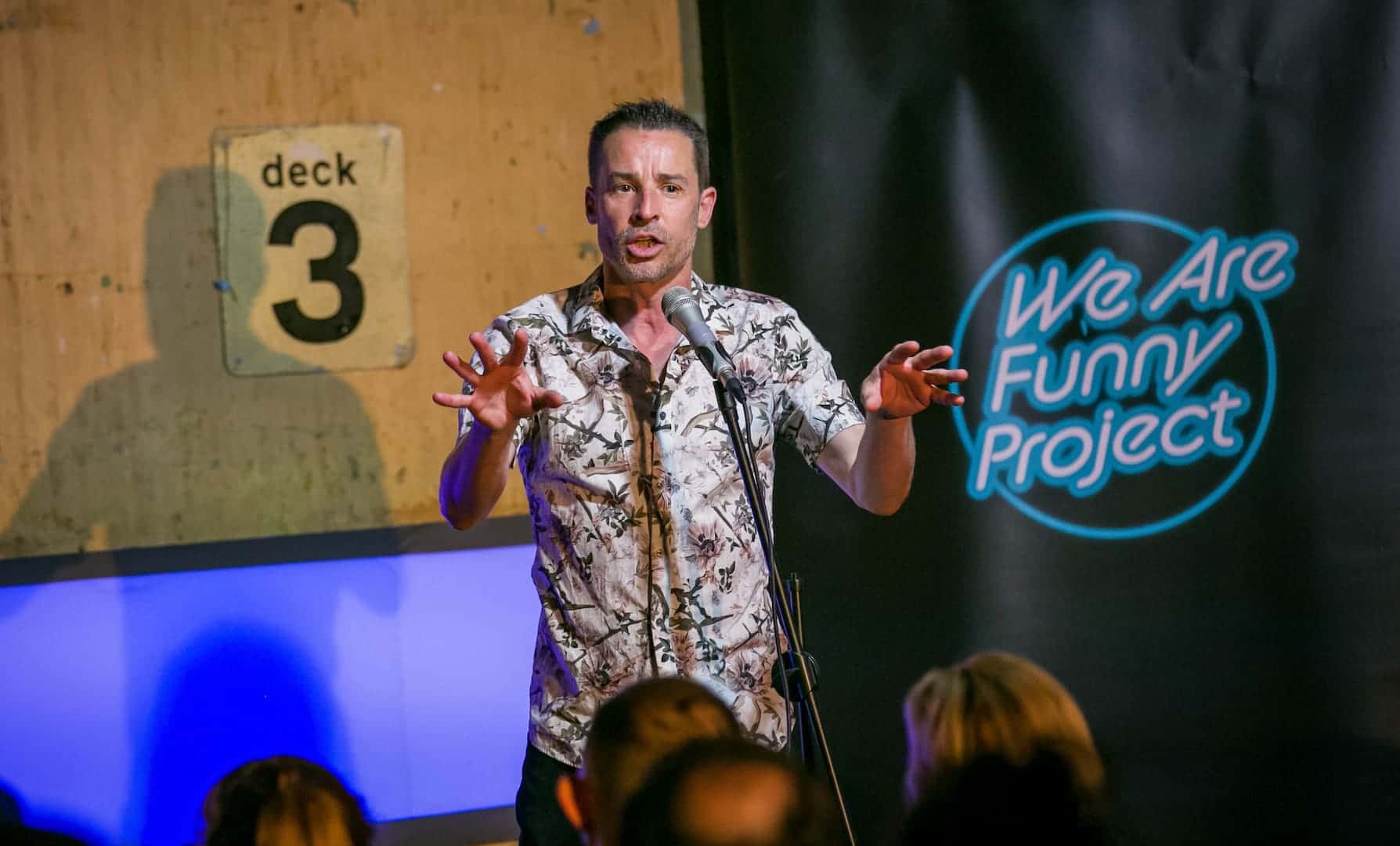
All photos courtesy of Steve Best at
www.stevebest.com
If the advice on this page has been useful, the courses are where it goes deeper.
Stepping Into Stand-Up Comedy is for comedians who are newer to the stage or still finding their feet with material. It covers how to write, how to structure and how to perform with confidence behind you.
Nearly 1,000 online reviews for We Are Funny Project and the review score is an average 4.9 out of 5, and there is a 30-day money-back guarantee.
Stepping Forward in Stand-Up Comedy is for comedians who are already gigging and want to push further. It is built around the Cinematic System and covers how to develop as a performer over the long term, not just the next gig.
Both courses are self-paced and available online.
People also ask
How do you get booked for open mic comedy gigs as a new comedian?
Most promoters receive far more requests than they have spots available. The acts who get booked consistently are reliable, professional in how they make contact and easy to work with on the night. Being a good comedian helps, but it is rarely the only factor. This blog covers the practical side in detail, from how to make the initial approach to the behaviours that quietly get you blacklisted.
How many open mic comedy gigs should a new comedian do?
As many as possible. Stage time is the single thing that cannot be replaced by any course, any coach or any amount of preparation. The early gigs are where you find out what your instincts actually are under pressure, and that knowledge only comes from doing it.
What do comedy promoters look for when booking acts?
Reliability is near the top of the list, alongside professionalism in how acts communicate and conduct themselves around the show. Comedy ability matters but so does being someone a promoter wants to invite back into their room. Acts who create problems, even minor ones, rarely get a second chance.
How do you stand out when booking open mic gigs?
Following the basic booking process correctly puts you ahead of a surprising number of people. Beyond that, being supportive of the show and the other acts on the bill, showing up on time and behaving well whether or not the set goes well are the things promoters remember. The bar for standing out positively is not as high as most new acts assume.